
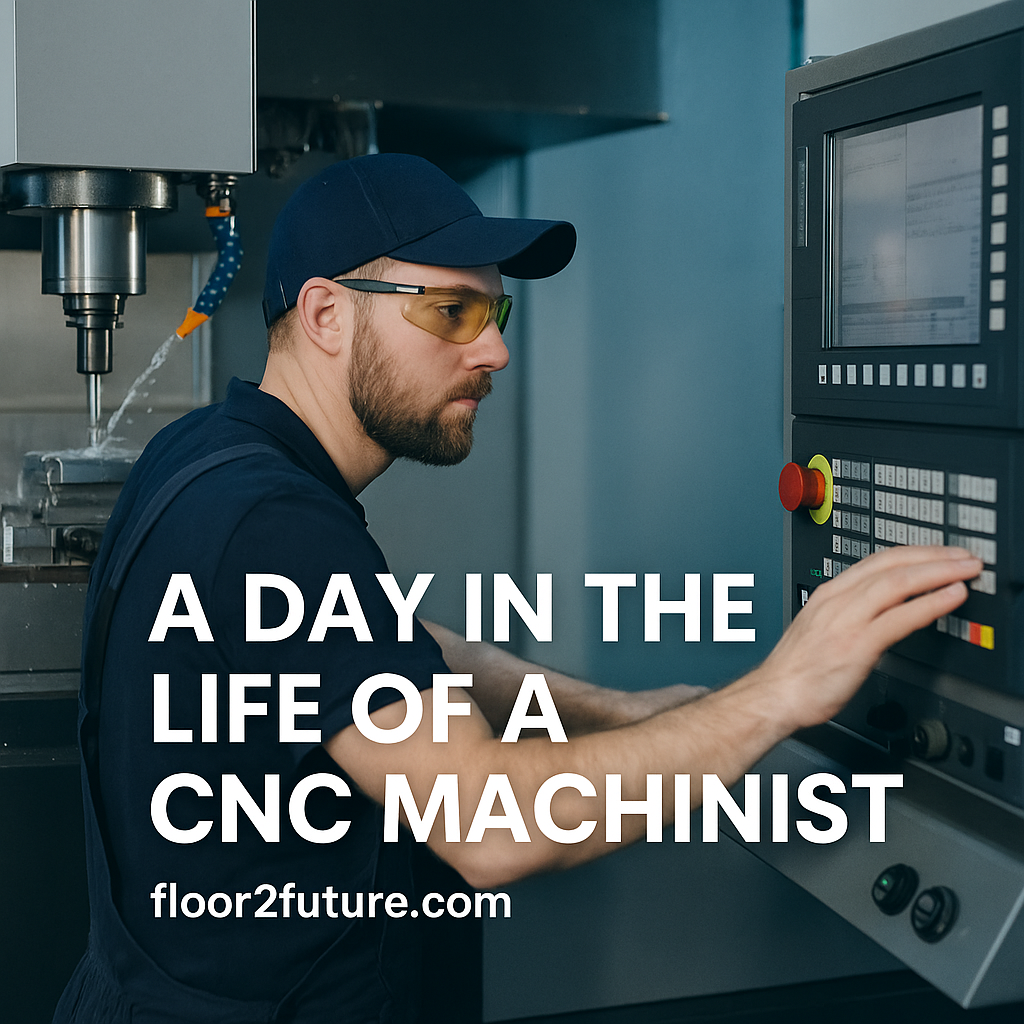
A Day in the Life of a CNC Machinist — And How Floor2Future.com Can Help You Start Your Career
Walk into any modern manufacturing facility today — automotive, aerospace, firearms, medical devices, or semiconductor technology — and you will find one role at the center of it all: the CNC machinist. These are the skilled professionals who turn raw material into precision components that power the machines, tools, and technologies our world depends on.
But what does a CNC machinist actually do each day?
What does the job feel like?
And more importantly — how can someone with zero experience build a future in this field?
The answer is simpler than most people think, and that’s where Floor2Future.com comes in. But first, let’s walk through a real day in the life of a CNC machinist.
The Start of the Shift: Precision Begins Before the Machine Turns On
Every day for a CNC machinist starts with preparation. Precision machining isn’t just about pressing buttons — it’s about planning and understanding the job ahead.
Most machinists begin their shift by:
- Reviewing job travelers and work orders
- Reading blueprints and technical drawings
- Verifying tools, holders, and fixtures
- Checking machine condition and safety features
- Loading or reviewing CNC programs
Before the first cut is made, they already know:
- What material they’re working with
- What dimensions and tolerances are required
- How many parts are due by end of shift
- What the potential challenges are
- Which tools will see the most wear
This level of preparation is what makes CNC machining professional craftsmanship rather than simple machine operation.
And here’s the exciting part:
➡️ Everything a machinist does in this stage can be taught — step by step, starting with free training at Floor2Future.com.
We help you understand the fundamentals, so when you walk into your first shop, you’re confident and ready.
Machine Setup: Where Skill Meets Hands-On Work
Once preparation is done, the machinist moves into setup — one of the most respected skills in the trade. Setup requires mechanical understanding, attention to detail, and problem-solving.
A typical setup might include:
- Installing vises, chucks, or custom fixtures
- Loading cutting tools into the turret, spindle, or tool magazine
- Setting tool length offsets
- Establishing part zero points and work offsets
- Loading raw material
- Dry-running the program to ensure safety
This is where machining becomes both art and science. A single mistake can scrap expensive parts, but a perfect setup means hours of smooth production.
And again, the path to learning this begins with:
➡️ Floor2Future.com’s beginner-friendly CNC entry training.
We help you understand the fundamentals of setup, tooling, offsets, and machine controls before you ever touch a real machine.
With the right training, these tasks are not hard — they become second nature.
Running Production: Monitoring, Adjusting, and Improving
As the machine starts cutting, the machinist becomes the guardian of the process.
Their responsibilities include:
- Checking dimensions using precision tools
- Listening for changes in machine behavior
- Monitoring tool wear
- Adjusting offsets
- Inspecting surface finishes
- Keeping an eye on coolant flow and chip buildup
Machinists quickly develop what many call a “machine sense.”
They can tell from sound, vibration, smell, and chip color if something is wrong long before alarms go off.
This is why machining is so much more than button-pushing — it’s skilled decision-making.
And all of this can be learned, practiced, and mastered with time.
➡️ Floor2Future.com trains you to understand machine behavior so you become valuable on day one.
Quality Checks: Precision Is the Whole Game
Machining is about accuracy — sometimes down to a few ten-thousandths of an inch. That’s why quality checks are a major part of a machinist’s day.
Common tasks include:
- Measuring with micrometers, calipers, bore gauges, height gauges
- Checking tolerances against print specs
- Inspecting threads, chamfers, and surface finishes
- Recording in-process inspection results
These checks not only ensure quality — they build pride in the work.
There is something incredibly satisfying about making a part with perfect dimensions.
Floor2Future.com teaches the basics of measurement tools, GD&T concepts, and inspection techniques so you enter the field already ahead of most beginners.
Problem Solving: The Machinist’s Superpower
No day is the same in CNC machining — and that’s why people love this career.
Machinists solve problems such as:
- Why is the tool wearing prematurely?
- Why is the part slightly oversized today?
- Should we adjust feed rate or spindle speed?
- Is the fixture allowing movement?
- Does the program need a minor tweak?
These challenges make the job engaging and mentally stimulating. It’s hands-on, high-tech, and rewarding.
And as you grow, your value skyrockets.
➡️ Floor2Future.com continues training you even AFTER you’re placed in a job.
We offer advanced skills training — free for our workers — to build you into a top-tier machinist.
End of Shift: Resetting for Tomorrow
At the end of the day, machinists:
- Clean the machine
- Remove chips
- Update production counts
- Tag maintenance issues
- Prepare materials for the next operator
- Document any changes or issues
Machinists take pride in their machine because it’s their craft, their responsibility, and often their pathway to higher pay and leadership roles.
**So How Do You Get Into CNC Machining?
Floor2Future.com Makes It Possible — Starting Today**
Here’s the truth:
✔ You do not need experience
✔ You do not need a degree
✔ You do not need to be a math expert
✔ You do not need previous factory work
You need:
🔥 Motivation
🔥 Dependability
🔥 A strong work ethic
🔥 Willingness to learn
Floor2Future.com exists for one purpose:
To take everyday people and train them into high-income manufacturing professionals.
When you join our program:
- You start with free required training
- Work ethic
- Body language
- Safety
- Communication
- Intro to CNC
- Intro to GD&T
- You complete your initial courses — all free.
- We place you with one of our partner companies.
These companies already know that Floor2Future talent is exceptional — trained, motivated, and reliable.
That’s WHY they want our people. - Once you start working, you get more free training.
- CNC basics
- G-code
- Lean manufacturing
- Leadership skills
- Promotion readiness
- Within a few years, you can reach $75,000 — $100,000+ annually.
Many machinists reach six figures with overtime or advancement.
Floor2Future literally means:
**From the manufacturing floor…
to the future of your career.**
And that future starts the moment you submit your information.
No resume?
No experience?
No problem.
➡ Go to Floor2Future.com and take your first step.
Your future is waiting — and it’s more achievable than you think.