Search for:
cnc salary range
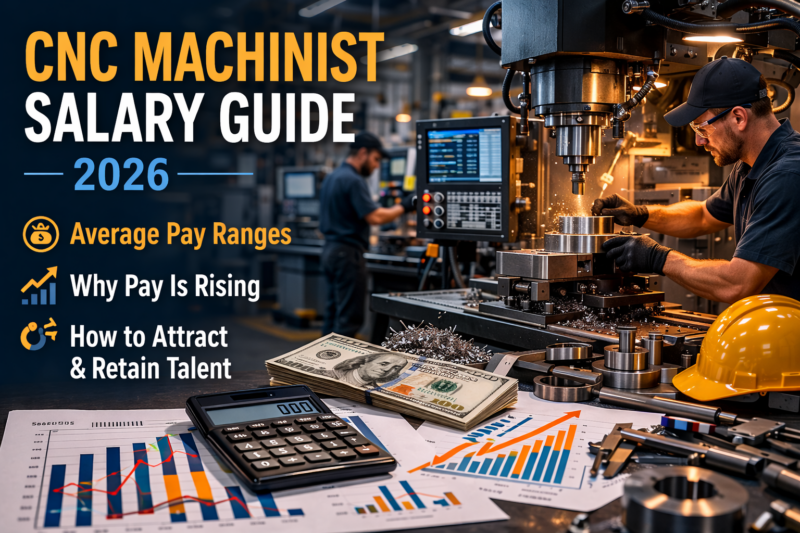
CNC Machinist Salary Guide (2026): What Manufacturers Must Pay to Hire and Keep Skilled Machinists

Across the manufacturing industry, one challenge continues to dominate conversations among plant managers, operations leaders, and HR professionals:

Finding skilled CNC machinists has become increasingly difficult.

Many manufacturers now find themselves competing for the same limited pool of experienced machinists capable of running CNC mills, lathes, and multi-axis machining centers. There is without a doubt a Machinist Shortage. Open roles often remain unfilled for months, and when qualified candidates appear, they frequently receive multiple offers.

One of the biggest drivers behind this challenge is rapidly changing wage expectations in the machining workforce.

Understanding what machinists are being paid—and why those wages are increasing—is essential for manufacturers who want to attract and retain skilled talent.

This guide provides a practical overview of CNC machinist salary ranges and explains what manufacturers must consider when building a competitive workforce strategy.


Average CNC Machinist Salaries in 2026

While pay varies by region, experience level, and industry specialization, CNC machinist wages have increased steadily across North America over the past several years.

Below are general salary ranges manufacturers are seeing in today’s labor market.

CNC Machine Operator

Typical Range: $20 – $28 per hour

These roles typically focus on running existing programs and performing basic production tasks such as loading parts, monitoring cycle times, and checking dimensions.

Operators often represent the entry point into machining careers.


CNC Machinist

Typical Range: $25 – $35 per hour

Machinists generally possess deeper technical knowledge and can perform tasks such as:

• adjusting offsets
• performing tool changes
• interpreting blueprints
• maintaining process stability

Many machinists are capable of troubleshooting machining issues during production.


CNC Setup Machinist

Typical Range: $30 – $40 per hour

Setup machinists are among the most valuable employees in a machining environment.

These professionals are responsible for:

• preparing machines for new jobs
• selecting tooling
• setting work offsets
• verifying part quality
• ensuring processes run efficiently

Because setup machinists have a combination of technical skill and production responsibility, demand for these workers is extremely high.


CNC Programmer

Typical Range: $35 – $50+ per hour

CNC programmers develop and optimize the programs used to manufacture parts.

Their responsibilities often include:

• writing and modifying G-code
• CAM programming
• toolpath optimization
• cycle time improvement
• troubleshooting complex machining challenges

Highly experienced programmers working with multi-axis equipment or complex aerospace components can earn significantly more.


Why Machinist Wages Are Increasing

Several long-term trends are pushing machinist wages upward.

Understanding these trends helps explain why manufacturers are struggling to fill open positions.


1. Retirement of Experienced Machinists

Many machinists currently working in the industry entered the trade decades ago during major manufacturing expansions.

As these workers approach retirement age, companies are losing decades of experience from the workforce.

Replacing that level of skill and knowledge is extremely difficult.


2. Declining Trade Education

Over the past twenty years, many vocational training programs focused on machining have disappeared from high schools and technical schools.

Students were increasingly encouraged to pursue four-year college degrees rather than skilled trades.

As a result, fewer young workers entered the machining profession.

The pipeline of new machinists began shrinking long before the industry fully recognized the consequences.


3. Increasing Technical Complexity

Modern machining environments are far more sophisticated than those of previous decades.

Machinists today must understand:

• blueprint reading
• inspection techniques
• tooling strategy
• feeds and speeds
• program logic
• process stability

Many machining roles now require both mechanical skill and technical understanding.

The increased complexity raises the skill threshold required to succeed in the field.


The Hidden Cost of Machinist Turnover

Many manufacturers underestimate the true cost of losing skilled machinists.

Replacing experienced employees often involves:

• recruiting costs
• lost production during vacancies
• training time for new hires
• reduced productivity during onboarding

Even when a new machinist is hired quickly, it can take months before they reach full productivity within a new shop environment.

For this reason, retention and workforce development are becoming increasingly important for manufacturing leaders.


Why Recruiting Alone Won’t Solve the Problem

Many companies attempt to address the machinist shortage by increasing wages and expanding recruiting efforts.

While competitive wages are important, recruiting alone cannot solve the underlying workforce problem.

The core issue is that the supply of skilled machinists is smaller than the industry demand.

When every manufacturer is competing for the same limited group of experienced machinists, recruiting becomes a constant battle.

This reality is forcing many organizations to rethink how they develop talent.


The Smarter Strategy: Develop Talent From Within

An increasing number of manufacturers are beginning to focus on developing machining talent internally.

Many facilities already have employees with the qualities required to become skilled machinists.

These individuals often work in roles such as:

• machine tending
• assembly
• secondary operations
• inspection

While they may not yet possess machining skills, many demonstrate the most important characteristics required for success:

• strong work ethic
• reliability
• attention to detail
• curiosity about machines and processes

These qualities are difficult to teach, but machining skills can be developed.

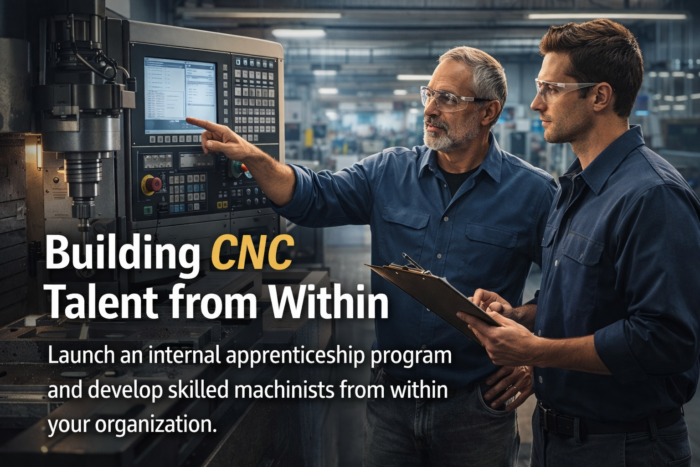
By creating internal apprenticeship programs and structured training paths, companies can build their own pipeline of machinists.


Combining Hands-On Training with Structured Learning

Successful workforce development programs often combine hands-on machining experience with structured learning.

Apprentices gain real-world experience operating machines while also developing foundational knowledge through training.

This structured approach helps employees understand:

• machining fundamentals
• measurement techniques
• tooling concepts
• process stability

The combination of hands-on experience and knowledge development accelerates skill growth.


The Future of the Machining Workforce

The machinist shortage is unlikely to disappear anytime soon.

Manufacturers who rely solely on hiring experienced machinists will continue facing significant workforce challenges.

Companies that invest in developing their own talent pipelines will be better positioned to maintain stable operations and support future growth.

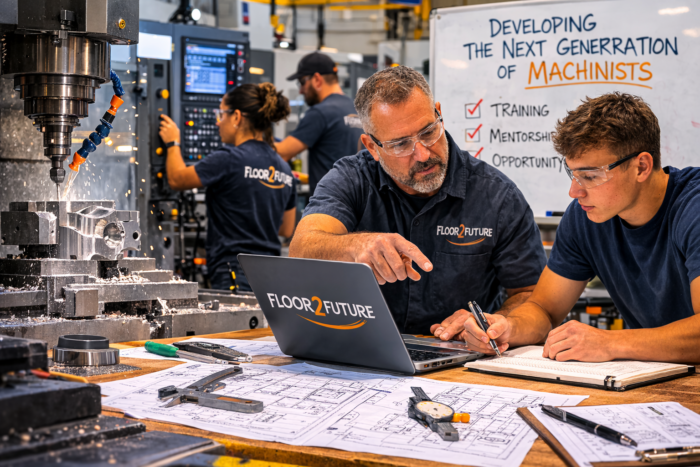
The next generation of machinists may already be working inside many manufacturing facilities.

They simply need the opportunity—and the training—to develop their skills.


How Floor2Future Helps Manufacturers Solve Workforce Challenges

Floor2Future helps manufacturing organizations address workforce challenges through a combination of recruiting, training, and apprenticeship program development.

Services include:

• recruiting manufacturing talent
• designing CNC apprenticeship programs
• creating structured machining training systems
• implementing online training modules and knowledge testing

By combining hands-on training with structured development systems, manufacturers can build sustainable talent pipelines that strengthen their workforce.

To learn more about developing the next generation of machinists, visit:

Floor2Future.com
The Machinist Shortage: Why Manufacturers Can’t Find Skilled CNC Operators

Across the manufacturing industry, one problem continues to surface in conversations with plant managers, operations leaders, and manufacturing executives.

Companies are struggling to find skilled CNC machinists.

Facilities running CNC mills and lathes often have open positions that remain unfilled for months. When qualified candidates do appear, they are usually competing offers from multiple manufacturers looking to fill the same roles.

For many organizations, the talent pool feels almost nonexistent.

While it may appear to be a hiring problem on the surface, the machinist shortage is actually the result of several deeper trends that have been building for decades.

Understanding these trends is critical for manufacturers who want to develop a sustainable workforce strategy.


A Workforce That Is Aging Out

One of the largest contributors to the machinist shortage is the retirement of experienced workers.

Many skilled machinists entered the trade during the manufacturing expansion of the 1970s, 1980s, and 1990s. These individuals spent decades mastering their craft and became the backbone of machining operations across the industry.

Today, a large percentage of those machinists are reaching retirement age.

As they leave the workforce, they take decades of knowledge with them.

Unfortunately, the number of new machinists entering the trade has not kept pace with the number leaving it.

This creates a widening gap between the demand for skilled machinists and the available supply.


The Decline of Trade Training

Another factor contributing to the shortage is the decline of vocational training programs.

For many years, high schools and community colleges offered strong machining and trade programs that introduced students to manufacturing careers. These programs served as a pipeline that helped prepare young workers for careers as machinists.

Over time, many of these programs disappeared.

Educational systems began placing greater emphasis on four-year college paths, often at the expense of skilled trade education.

As a result, fewer students were exposed to machining as a career option.

The pipeline of entry-level machinists began shrinking long before the industry fully realized the impact.


Modern Machining Is More Complex

At the same time the workforce pipeline was shrinking, the technical complexity of machining was increasing.

Modern CNC machining requires more than simply running parts on a machine.

Operators and technicians must understand:

• blueprint reading
• measurement and inspection
• tooling and offsets
• feeds and speeds
• program logic
• process stability

Many machining roles now require a combination of technical skill, mechanical aptitude, and analytical thinking.

This raises the bar for new entrants into the field.

Companies are no longer just looking for machine operators. They are looking for individuals capable of managing increasingly sophisticated manufacturing processes.


The Competition for Skilled Machinists

Because the supply of skilled machinists is limited, companies are now competing heavily for experienced workers.

When a skilled machinist becomes available in the job market, multiple companies often pursue the same individual.

This leads to:

• higher recruiting costs
• wage escalation
• long vacancy periods for open positions

Even when a company successfully hires an experienced machinist, they must often compete to retain that employee.

Recruiting alone has become an increasingly difficult strategy for solving workforce challenges.


Why Hiring Alone Won’t Solve the Problem

Many manufacturers continue to approach the machinist shortage as a recruiting challenge.

They increase wages, expand job postings, and work with recruiting agencies to locate candidates.

While recruiting remains important, it cannot solve the underlying workforce issue by itself.

The fundamental problem is that the supply of skilled machinists is simply too small to meet industry demand.

When every company is competing for the same limited talent pool, recruiting becomes a zero-sum game.

One company may fill a role, but another company will still be left searching.

This reality is forcing more manufacturers to rethink how they develop their workforce.


Looking Inside the Organization

Many manufacturing facilities already have individuals capable of becoming skilled machinists.

These employees may currently work in roles such as:

• machine tending
• assembly
• secondary operations
• inspection
• material handling

While they may not yet possess machining experience, many already demonstrate the most important traits required for success.

These traits include:

• strong work ethic
• reliability
• attention to detail
• mechanical curiosity
• willingness to learn

These qualities cannot easily be taught.

But machining skills can.

When organizations begin viewing their workforce through this lens, they often discover that potential machinists are already inside their facility.

They simply need the opportunity to develop.


The Return of Apprenticeship Thinking

For decades, machining skills were traditionally developed through apprenticeship-style learning.

Experienced machinists mentored younger workers, gradually transferring knowledge and technical skill through hands-on experience.

While many companies moved away from formal apprenticeship models, the concept is now gaining renewed attention.

Internal apprenticeship programs allow manufacturers to create structured development paths that guide employees from entry-level roles into skilled machining positions.

Instead of hoping to recruit experienced machinists, companies can begin developing them internally.

This approach creates a sustainable talent pipeline that strengthens the organization over time.


Combining Hands-On Training with Structured Learning

One of the challenges of apprenticeship programs is ensuring that training is consistent and measurable.

Traditionally, training relied heavily on verbal instruction and informal mentoring. While mentorship remains extremely valuable, it can sometimes lead to inconsistent knowledge transfer.

Modern apprenticeship programs are increasingly combining hands-on shop floor training with structured learning systems.

Online training modules, knowledge testing, and development milestones allow companies to create clear learning paths for apprentices.

This ensures that employees not only gain practical experience but also build the technical knowledge required to succeed in machining roles.


The Future of the Manufacturing Workforce

The shortage of skilled machinists is not likely to disappear in the near future.

Manufacturers who rely solely on external hiring will continue to face increasing difficulty filling critical roles.

Organizations that begin developing their own talent pipelines will be better positioned to adapt to this changing workforce landscape.

By identifying motivated employees and creating structured development opportunities, companies can build the next generation of skilled machinists inside their own operations.

The future of manufacturing workforce development will depend not just on recruiting talent—but on cultivating it.


How Floor2Future Can Help

Floor2Future works with manufacturing organizations to address workforce challenges through a combination of recruiting support, apprenticeship program development, and structured training systems.

Through online training modules, testing systems, and apprenticeship frameworks, Floor2Future helps companies develop skilled machinists from within their workforce while strengthening long-term talent pipelines.

To learn more about building a sustainable manufacturing workforce, visit:

Floor2Future.com

cnc apprenticeship program
Building Talent From Within: Why More Manufacturers Need Internal CNC Apprenticeship Programs

One of the most persistent challenges facing modern manufacturing is not technology, automation, or even global competition. The challenge is people.

Across the industry, companies are struggling to find skilled machinists capable of operating CNC mills and lathes. Experienced programmers, setup technicians, and machinists are increasingly difficult to recruit, and when companies do find qualified candidates, the competition for that talent is intense.

The reality is simple: the external talent pool for skilled machining roles is extremely thin.

This situation has forced many manufacturing leaders to rethink a fundamental question:

What if the solution isn’t hiring talent from outside the organization, but developing it from within?

More companies are beginning to recognize that the most reliable way to build a strong workforce is by curating talent internally through structured apprenticeship programs.


The Shrinking Pool of Skilled Machinists

For decades, machining was a trade passed down through apprenticeship and hands-on training. Experienced machinists mentored younger operators, and skills were developed over time on the shop floor.

However, over the past twenty years, several factors have reduced the number of skilled machinists entering the workforce:

  • Fewer vocational programs focused on machining
  • A cultural shift away from skilled trades
  • Retirements from the experienced manufacturing workforce
  • Increasing technical complexity in CNC machining

At the same time, modern machining requires more skill than ever. Operators must understand tooling, offsets, inspection, feeds and speeds, program logic, and process control.

Simply hiring someone off the street and expecting them to succeed is rarely realistic.

The pipeline of experienced machinists simply isn’t large enough to support the industry’s demand.


Looking Inside the Organization

Many manufacturing facilities already have something extremely valuable inside their own walls: people who are capable of becoming skilled machinists.

These individuals may currently work in roles such as:

  • secondary operations
  • assembly
  • machine tending
  • inspection
  • material handling

While they may not yet have machining expertise, many of them possess the most important qualities needed for success:

  • strong work ethic
  • reliability
  • mechanical curiosity
  • attention to detail
  • commitment to the organization

These traits cannot easily be taught, but machining skills can.

That realization has led many companies to consider a more strategic approach to workforce development: internal apprenticeship programs.


The Concept of an Internal CNC Apprenticeship

An internal apprenticeship program allows companies to identify promising employees and gradually develop them into skilled machinists.

Rather than relying solely on outside hiring, organizations intentionally create a pipeline of talent that grows from within the business.

In a typical CNC apprenticeship program, selected employees move through several stages of development:

Stage 1: Machine Familiarization

Apprentices begin by learning the basics of machine operation, safety procedures, and shop fundamentals.

They observe experienced machinists and develop an understanding of the machining environment.

Stage 2: Machine Operation

At this stage, apprentices begin operating CNC machines under supervision. They learn basic tasks such as:

  • loading parts
  • monitoring cycle times
  • checking dimensions
  • understanding work instructions

This phase builds confidence and introduces them to the rhythm of production machining.

Stage 3: Setup and Tooling

As apprentices progress, they begin learning more advanced responsibilities, including:

  • tool changes
  • offsets
  • workholding
  • basic machine setup

This stage represents the transition from operator to technician.

Stage 4: Process Understanding

The final stage focuses on deeper process knowledge, including:

  • reading programs
  • understanding feeds and speeds
  • troubleshooting machining issues
  • maintaining process stability

By the end of this progression, the apprentice has developed the core skills required to operate and support CNC machining operations.


The Benefits of Developing Talent Internally

Companies that implement internal apprenticeship programs often discover several significant benefits.

1. Loyalty and Retention

Employees who are given opportunities to grow within an organization tend to develop stronger loyalty to the company.

When workers see a clear path for advancement, they become more invested in their careers and in the success of the organization.

2. Cultural Strength

Promoting from within reinforces a positive culture where employees understand that hard work and dedication are recognized.

This encourages others in the organization to develop their skills as well.

3. Operational Stability

External hiring always carries uncertainty. New hires must adapt to company culture, processes, and expectations.

Internal apprentices already understand the organization. They know the people, the systems, and the workflow.

This makes their transition into skilled roles smoother and more predictable.

4. Long-Term Workforce Sustainability

Perhaps most importantly, apprenticeship programs create a continuous talent pipeline.

Instead of scrambling to fill roles when experienced machinists retire or move on, companies maintain a steady flow of trained personnel ready to step into more advanced roles.


A Strategy More Manufacturers Should Consider

The manufacturing industry is entering a period where workforce development will become one of the most critical leadership responsibilities.

Technology will continue to advance. Machines will become faster, more precise, and more automated.

But the need for skilled people who understand the process will never disappear.

Organizations that rely solely on hiring from the outside will continue to struggle in a shrinking labor market.

Companies that invest in developing their own talent will build stronger, more resilient teams.

Internal apprenticeship programs represent one of the most practical ways to accomplish this.

By identifying motivated employees and giving them the opportunity to grow into skilled machinists, manufacturers can address one of the industry’s most pressing challenges while simultaneously strengthening their culture and workforce.

The talent may already be inside the building.

It simply needs the opportunity to be developed.

New Book Release: The 80/20 Lean Field Manual Introduces a Simpler Approach to Manufacturing Improvement

Manufacturing companies across the world continue to search for better ways to improve productivity, quality, and operational efficiency. While Lean manufacturing has long been a cornerstone of continuous improvement, many organizations struggle with the complexity that often comes with large-scale Lean programs.

A new book, The 80/20 Lean Field Manual, aims to change that.

Written by manufacturing professional Sean Odell, the book introduces a practical and simplified approach to Lean manufacturing by applying one of the most powerful concepts in business: the 80/20 principle.


A Simpler Approach to Lean Manufacturing

The core idea behind the book is straightforward. In most manufacturing operations, a small number of problems create the majority of operational challenges. Rather than spreading improvement efforts across dozens of initiatives, The 80/20 Lean Field Manual encourages leaders to focus on the “vital few” issues that have the greatest impact on results.

By identifying and addressing these key problems, manufacturers can often achieve dramatic improvements in performance while reducing the complexity of their improvement programs.

The book is designed as a practical field guide, making it accessible not only for executives and engineers, but also for supervisors, team leaders, and operators working directly on the manufacturing floor.


Why Many Lean Programs Struggle

While Lean principles have transformed many organizations, the reality is that many improvement programs become overly complicated. Teams often spend significant time tracking metrics, running meetings, and launching multiple initiatives, yet struggle to see meaningful results.

The 80/20 Lean Field Manual challenges this approach by returning to a fundamental principle: not all problems are equal.

In most factories, a small number of operational constraints—bottlenecks, quality issues, or process inefficiencies—are responsible for a large percentage of lost productivity. By focusing attention on these critical areas, organizations can generate improvements that ripple throughout the entire operation.


Practical Lessons for Manufacturing Leaders

Throughout the book, readers learn how to:

  • Identify the most impactful operational problems in their facility
  • Avoid wasted effort on low-value improvement activities
  • Improve throughput and productivity by focusing on real constraints
  • Apply Lean thinking in a practical, floor-level way
  • Build a culture that prioritizes meaningful operational impact

Rather than presenting Lean as a complex system requiring large teams and extensive training, the book reframes it as a focused discipline centered on identifying and solving the problems that matter most.


A Tool for Today’s Manufacturing Environment

Modern manufacturing environments face increasing pressure to produce higher quality products, maintain tight cost control, and respond quickly to market changes. In this environment, improvement strategies must be both effective and efficient.

By combining Lean manufacturing principles with the 80/20 rule, The 80/20 Lean Field Manual offers a framework that helps organizations concentrate their efforts where they will produce the greatest results.


Now Available on Amazon

The 80/20 Lean Field Manual is now available for purchase on Amazon.

Manufacturing professionals interested in simplifying their improvement efforts and focusing on the most impactful operational opportunities can learn more about the book and how the 80/20 principle can transform Lean thinking.


About the Author

Sean Odell is a manufacturing professional with extensive experience in operations leadership, process improvement, and Lean manufacturing. Throughout his career, he has focused on identifying practical methods that help companies improve productivity, quality, and efficiency while keeping improvement efforts focused on the areas that deliver the greatest impact.

Cincinnati Workforce Initiative Highlights 3 Behaviors That Lead to Promotion in Manufacturing

Floor2Future releases new career advancement guide aimed at strengthening the Greater Cincinnati manufacturing workforce

Amelia, OH — As manufacturing continues to play a critical role in the Greater Cincinnati economy, Floor2Future has released a new career advancement article designed to help local workers move beyond entry-level roles and into leadership positions.

The article, titled “The 3 Behaviors That Get You Promoted in Manufacturing,” outlines practical, behavior-based principles that supervisors consistently look for when identifying future leaders on the shop floor.

Cincinnati’s manufacturing sector spans aerospace, automotive, metal fabrication, advanced machining, and industrial production. While technical skills remain important, Floor2Future founder Sean [Last Name] emphasizes that behavioral consistency is often the true differentiator.

“Promotions in manufacturing aren’t random,” Sean said. “In plants across the Cincinnati region, supervisors are watching patterns. They promote reliability, ownership, and respect for process.”

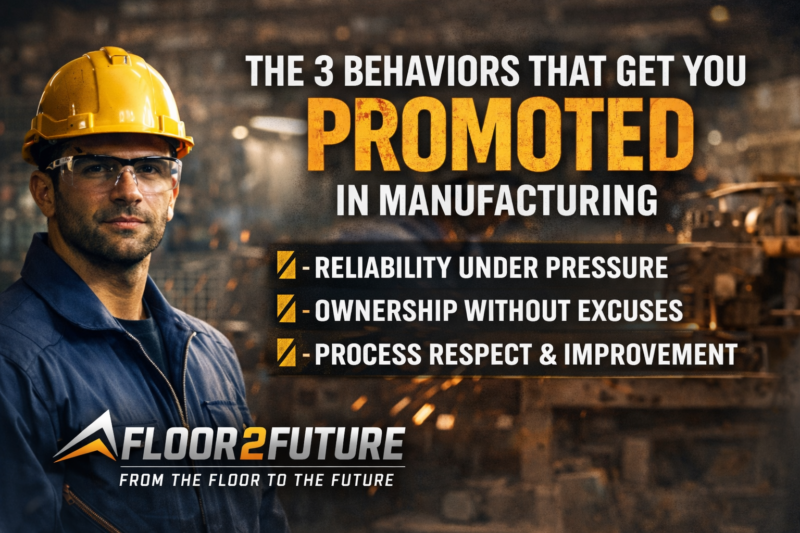
The article identifies three core behaviors that consistently separate promotable employees from the average workforce:

1. Reliability Under Pressure
Maintaining steady performance during tight production schedules and operational challenges.

2. Ownership Without Excuses
Taking responsibility for outcomes and solving problems without deflection.

3. Process Respect and Continuous Improvement
Understanding how quality, cost, and throughput impact the entire operation — not just one workstation.

With manufacturers across Southwest Ohio continuing to seek dependable, promotable talent, the article serves as both guidance for workers and insight for employers.

In addition to publishing workforce development content, Floor2Future provides free foundational training for candidates in areas such as:

  • Work Ethic fundamentals
  • Professional communication
  • Safety awareness
  • Workplace professionalism

“Manufacturing offers real upward mobility in Cincinnati,” Sean added. “But advancement comes from consistency, not intensity. We’re helping workers understand what actually gets them promoted.”

Floor2Future partners with regional manufacturers to connect disciplined, prepared candidates with long-term career opportunities while reinforcing professional standards that strengthen the local workforce.

career opportunities
Manufacturing Isn’t About Working Hard — Manufacturing Success Starts With Consistency

Let’s clear something up.

Manufacturing is not about breaking your back.
It’s not about being the toughest person in the room.
It’s not about exhausting yourself to prove something.

It’s about one thing:

Consistency.

And consistency beats raw effort every single time.


Stop Thinking “Hard Work.” Start Thinking “Relentless Discipline.”

Hard work is emotional.

Discipline is controlled.

Hard work burns people out.
Discipline builds careers.

Manufacturing rewards the person who:

  • Shows up on time — every time
  • Pays attention — every shift
  • Follows the process — every part
  • Protects quality — every order

You don’t need hero moments.

You need steady performance.


The Industry Is Watching

Supervisors notice patterns.

They see who drifts.
They see who complains.
They see who checks out early.

But they also see:

  • The operator who keeps the machine running
  • The team member who fixes small problems before they grow
  • The person who doesn’t make excuses

That person moves up.

Not because they “worked harder.”

Because they were consistent when others weren’t.


The 80/20 Reality of Work Ethic

Here’s the truth most people miss:

20% of employees carry 80% of the reliability.

If you choose to be in that 20%, you don’t need to chase opportunity.

Raises.
Cross-training.
Leadership roles.
Better shifts.

They come to you.

Consistency puts you in the top tier.


And You Don’t Have to Do It Alone

When you work with Floor2Future, you’re not just getting placed into a job.

You’re getting an edge.

We provide free training along the way, including:

  • Work Ethic fundamentals
  • Professional communication basics
  • Safety awareness
  • Body language in the workplace

These aren’t just “courses.”

They are competitive advantages.

Most people show up to work hoping to figure it out.

Our candidates show up prepared.


You Don’t Need Talent. You Need Standards.

You don’t have to know everything.

You don’t have to be the fastest.

You don’t have to be the most experienced.

But you do need standards:

  • No excuses
  • No shortcuts
  • No “good enough” mentality
  • No clock-watching mindset

Bring steady effort.
Protect your reputation.
Improve a little every week.

That’s how real careers are built in manufacturing.


From the Floor to the Future

If you want more than just a paycheck…

If you want upward movement…

If you want to build something real…

Then commit to consistency.

We’ll help you build the skills.

You bring the discipline.

That’s how you move from the floor to the future.


Ready to Separate Yourself From the Average?

If you’re serious about building a career in manufacturing — not just collecting a paycheck — take the next step.

When you work with Floor2Future, you don’t just get placed into a position.

You get:

  • Free foundational training
  • A structured path for growth
  • Ongoing career support
  • Access to companies that value discipline and reliability

Most people apply for jobs.

Our candidates prepare for careers.

Apply today and start building your future.

consulting services manufacturing
Introducing 80/20 Lean Consulting Services

Continuous Improvement Without the Continuous Improvement Payroll

Manufacturing companies don’t struggle because they lack effort.

They struggle because they’re focused on too many things at once.

For decades, large corporations have relied on dedicated continuous improvement teams — Lean managers, Black Belts, process engineers — all focused on driving operational efficiency.

But what about small to mid-sized manufacturers?

What about the companies that can’t justify a full-time CI department… yet still need results?

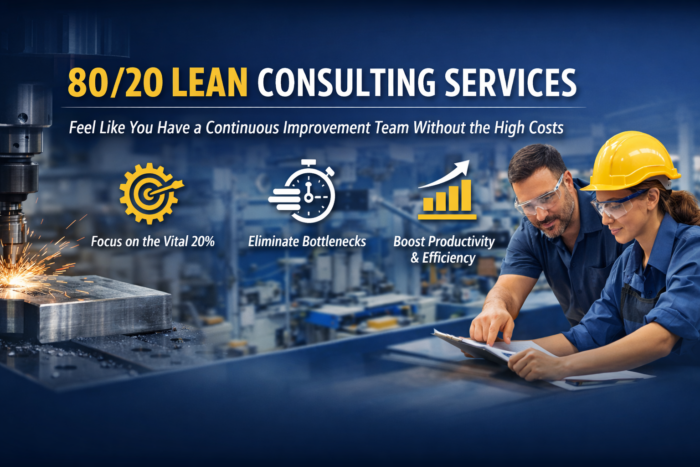
That’s exactly why we are launching 80/20 Lean Consulting Services.


The Problem Most Manufacturers Face

If you walk the floor of most shops, you’ll see:

  • Machines waiting on material
  • Operators waiting on instructions
  • Work-in-progress stacking up
  • Accounting frustrated with margin compression
  • Leadership reacting instead of leading

Everyone is working hard.

But the effort is scattered.

The truth is simple:
80% of operational pain usually comes from 20% of the processes.

Yet most improvement efforts try to fix everything at once.

That’s expensive.
That’s slow.
And that’s why many Lean initiatives fade away.


The 80/20 Lean Approach

Our consulting services are built around one core principle:

Identify the vital few that drive the majority of results.

We don’t start with theory.
We start with:

  • Throughput history
  • Bottleneck analysis
  • Financial pain points
  • Floor observation
  • Constraint movement

We identify the top one or two bottlenecks.

Then we calculate:

  • How much time must be reduced to move the constraint
  • What that time reduction is worth in revenue
  • What that bottleneck is costing per hour, per shift, per month

This turns improvement into a financial conversation — not just an operational one.


Designed for Small to Mid-Sized Manufacturers

This service is ideal for companies that want to feel like they have a continuous improvement team — without carrying the full-time payroll of one.

Instead of hiring:

  • A Lean Manager
  • A Process Engineer
  • A Six Sigma Black Belt

You gain focused, strategic guidance aimed directly at the highest-impact areas.

Not 50 initiatives.

Not “flavor of the month” programs.

Just the vital few.


What You Can Expect

With 80/20 Lean Consulting, companies typically gain:

  • Improved throughput without major capital investment
  • Reduced bottleneck stagnation
  • Clear alignment between operations and accounting
  • Stronger leadership clarity
  • Faster implementation cycles

This is not theory-based Lean.

This is floor-driven Lean.


Continuous Improvement Shouldn’t Be a Luxury

Continuous improvement should not be reserved for Fortune 500 companies.

It should be accessible, practical, and measurable for every manufacturer.

That’s what this launch represents.

A simpler path.
A sharper focus.
A disciplined application of the 80/20 principle inside manufacturing operations.


Ready to Get Started?

If you’re a manufacturer who:

  • Feels stuck in reactive mode
  • Knows there’s waste but can’t pinpoint it
  • Wants measurable results without adding overhead
  • Wants to align operations with profitability

We should talk.

The 80/20 Lean Consulting Services are now live.

Let’s identify your vital few — and move your constraint forward.

best project management system
Why Task27 Is a Strategic Expansion of the Floor2Future Ecosystem

At Floor2Future.com, we have never viewed recruiting, training, and leadership development as isolated services.

They are systems.

And systems require structure.

That’s why we are expanding our digital ecosystem with the integration of Task27, our premier project management platform designed to strengthen execution across recruiting, training, operational improvement, and upcoming franchise territories.

This is not about adding software.

It’s about reinforcing infrastructure.


From Services to Systems

Floor2Future was built around one core belief:

Impacting companies and careers requires structure, accountability, and disciplined execution.

We help companies:

  • Recruit the right people
  • Train them effectively
  • Develop strong leaders
  • Improve operational performance

But delivering these services at scale demands more than expertise. It demands coordination.

Task27 provides that coordination.

Instead of relying on disconnected tools, scattered emails, or spreadsheet tracking, Task27 centralizes:

  • Project workflows
  • Recruiting milestones
  • Training rollouts
  • Leadership initiatives
  • Client engagements

Everything moves through one organized system.


Why Project Management Matters in Workforce Development

Recruiting is not just interviews.

Training is not just content.

Leadership development is not just instruction.

Each of these requires timelines, accountability, communication, and measurable execution.

Task27 gives Floor2Future the ability to:

  • Track recruiting pipelines with structure
  • Coordinate onboarding programs
  • Manage custom training deployments
  • Monitor leadership implementation plans
  • Maintain visibility across teams

This ensures clients experience consistency, not chaos.


A Franchise-Ready Foundation

As Floor2Future prepares for upcoming franchise availability, systemization becomes critical.

Franchise growth only works when processes are standardized.

Task27 serves as the operational backbone for future franchise partners by providing:

  • Defined workflows
  • Clear task ownership
  • Transparent communication
  • Measurable accountability
  • Unified operational standards

Rather than each territory improvising its own systems, franchise owners will operate within a structured, proven framework.

That structure protects brand integrity and increases the likelihood of long-term success.


Discipline Over Noise

The market is crowded with enterprise software that promises everything.

Task27 focuses on execution.

It is clean.
It is practical.
It is built for accountability.

It reinforces our philosophy that operational clarity beats complexity.


Building for Long-Term Impact

Floor2Future is expanding intentionally.

Recruiting.
Training.
Leadership development.
Operational improvement.

Now strengthened by structured project management infrastructure.

Task27 represents the next step in building a scalable ecosystem capable of impacting companies and careers at a national level.

As we move toward franchise expansion, this investment in digital systems ensures that growth will be disciplined, measurable, and aligned with our mission.

The future of workforce development is not fragmented.

It is structured.

And Task27 is part of that foundation.

Why Modern Manufacturing Needs a Bottom-Up Workforce Model

Modern manufacturing is in the middle of a paradox. Investment is rising, technology is accelerating, and the need for skilled production talent has never been higher—yet many manufacturers still struggle to fill roles, stabilize teams, and build a pipeline that lasts.

The reason isn’t mysterious. The “skills gap” is real, but it’s not just about CNC, PLCs, metrology, or blueprint reading. It’s also about retention, expectations, leadership depth, and whether workers see a future in the work—or just another short stop on the road to somewhere else.

That’s the backdrop for Floor2Future.com: a platform designed to strengthen manufacturing from the ground up by developing stronger contributors, building better team leads, and creating clearer career pathways that benefit both people and companies.

The Pressure Is Rising: Open Roles and a Shrinking Pipeline

Manufacturers across the U.S. are facing a widening workforce shortfall. The National Association of Manufacturers has highlighted that the U.S. could face a shortfall of 1.9 million manufacturing workers by 2033, with 3.8 million positions expected to open and nearly half potentially going unfilled—despite manufacturing offering strong total compensation.

That statistic matters because it reframes the conversation. This isn’t a “recruiting problem” solved by posting more jobs. It’s a structural pipeline issue involving retirements, growth, competition for talent, and the increasing complexity of manufacturing work.

At the same time, technology is changing what “qualified” even means. Automation, advanced inspection, digital work instructions, and data-driven process control are elevating expectations at the operator level. Hiring managers increasingly need candidates who can learn quickly, adapt, communicate, and take ownership—not just show up.

The Skills Gap Is Also a Mindset and Leadership Gap

One of the biggest misconceptions in workforce development is that the gap can be solved by technical training alone. A credential helps—but it doesn’t automatically create reliability, judgment, communication, or pride in workmanship.

Multiple credible sources point to this broader shift in skill requirements. A World Economic Forum theme across its workforce work is that a large portion of skills are expected to change over a short time horizon; Deloitte’s workforce analysis cites the WEF’s findings that substantial skill requirements will evolve as advanced manufacturing transforms.

In plain terms: even if you train someone today, the job they do two years from now may require a different mix of technical ability, digital comfort, and soft skills. That means the workforce solution must be designed for ongoing development, not one-and-done orientation.

Why Retention Breaks the System (Even When Hiring “Works”)

Let’s say a company does manage to hire. If turnover stays high, the system never stabilizes:

  • Training becomes constant re-training
  • tribal knowledge leaks out the door
  • quality suffers under churn
  • supervisors spend their time “patching holes” instead of improving process
  • top performers burn out from carrying the load

This is why workforce development has to connect directly to daily behaviors: accountability, attendance, standard work discipline, problem escalation, and teamwork. If those fundamentals don’t improve, the revolving door wins—no matter how many ads you run.

Even manufacturer sentiment surveys reflect how persistent workforce difficulty remains as a business constraint. The National Association of Manufacturers Manufacturers’ Outlook Survey has consistently tracked workforce attraction and retention as a major concern for manufacturers in recent years.

The “Bottom-Up” Solution: Start Where the Work Happens

Manufacturing performance is ultimately created at the point of execution: the cell, the line, the machine, the inspection bench, the material flow lane. Yet most workforce strategies overemphasize top-down elements (policies, compensation structures, job postings) and underemphasize the bottom-up drivers (skill-building, pride, leadership habits, and shop-floor communication).

A bottom-up workforce model focuses on:

  1. Operator readiness as a core business lever
    Not just “filled seats,” but people who can meet the moment: safe work, consistent output, quality awareness, and continuous improvement participation.
  2. Clear expectations and personal standards
    Many failures are expectation failures. A bottom-up approach makes success requirements obvious early—before bad habits become culture.
  3. Leadership development at the first rung
    Companies promote their best technical people into lead roles and hope it works out. Often, they don’t get the structure or coaching needed to lead consistently. Building strong team leads is one of the highest-leverage moves a plant can make.
  4. Career pathways that feel real
    When employees can see the ladder—and believe it’s attainable—they stay longer, learn faster, and contribute more. The alternative is “job hopping” as the default path to pay growth.

Where Floor2Future Fits: Workforce Development That Serves Both Sides

Floor2Future.com is built to align incentives for both workers and manufacturers:

  • For workers: a clearer path from entry-level to advanced responsibility, plus development in the skills that actually unlock promotions—reliability, communication, leadership behavior, and continuous improvement thinking.
  • For companies: a pipeline of candidates who are more prepared for real production environments, and a framework that supports retention and stability—not just hiring volume.

This is also where the model departs from traditional recruiting. Recruiting is often transactional: fill the job, move on. Workforce development is compounding: when you build capability and culture, performance improves month after month.

Digital Real Estate That Supports the Mission

A strong workforce model needs infrastructure—places where people can enter the ecosystem, learn what’s expected, and connect with opportunities. That’s one reason Road2Jobs.com exists: as a focused platform supporting manufacturing roles while reinforcing the broader goal of improving readiness and fit, not just “applications per posting.”

Digital real estate matters because attention is fragmented. Workers search across multiple platforms; employers do the same. Owning a purpose-built entry point makes it possible to build consistency—consistent messaging, consistent expectations, consistent development pathways.

The Big Opportunity: Rebuilding Trust Between Employers and Workers

If you zoom out, the manufacturing workforce challenge is partly a trust challenge.

  • Employers worry about attendance, engagement, and dependability.
  • Workers worry about instability, burnout, and lack of growth.

A bottom-up approach rebuilds trust through performance and clarity:

  • workers know what great looks like and how to earn more responsibility
  • employers get people who understand the job and take pride in execution
  • leadership becomes more consistent and less reactive

That’s how you improve the “landscape” of modern manufacturing—not with hype, but with systems that make success more likely.

Where This Goes Next

The manufacturers who win the next decade won’t just buy better machines. They’ll build better people systems—where capability grows, leadership is trained, and shop-floor execution becomes a competitive advantage.

That’s the aim of Floor2Future: to help create manufacturing careers that last, and manufacturing businesses that can scale without being held hostage by turnover and talent shortages.

If you’re a manufacturer trying to stabilize performance—or a worker looking to build a real career path—Floor2Future is designed to be a practical bridge between today’s needs and the future you’re trying to reach.

Road2Jobs.com: Building a Stronger Pathway Into Modern Manufacturing

The manufacturing industry is evolving faster than ever—driven by technology, automation, and shifting workforce expectations. Yet one critical area continues to lag behind: how people enter, navigate, and grow within manufacturing careers. At Floor2Future.com, we believe that solving this challenge requires more than traditional recruiting or job postings. It requires a connected ecosystem built around preparation, expectations, and long-term success.

That belief is what led to the creation of Road2Jobs.com.

The Floor2Future Model: More Than Placement

Floor2Future.com was built on a simple but often overlooked principle: strong manufacturing companies are built by developing people, not just filling positions. Our model integrates workforce development, training, and career-long support to help individuals become reliable contributors and future leaders—while helping manufacturers reduce turnover, improve performance, and build stability.

Rather than operating as a traditional recruiting firm, Floor2Future focuses on alignment. We work to ensure individuals understand what modern manufacturing demands, and that companies receive candidates who are motivated to build careers, not just collect paychecks.

Road2Jobs.com exists as a critical extension of that model.

What Road2Jobs.com Is Designed to Do

Road2Jobs.com is a workforce-focused digital platform dedicated specifically to manufacturing roles. It is not a generic job board. It is purpose-built to improve how people connect with manufacturing opportunities—and how manufacturers identify talent that fits both technically and culturally.

The platform emphasizes:

  • Clear expectations about manufacturing environments
  • Career pathways rather than one-off placements
  • Workforce readiness and mindset, not just resumes

By reframing how jobs are presented and how candidates engage, Road2Jobs.com helps raise the overall quality of the hiring conversation on both sides.

Improving the Manufacturing Landscape

Modern manufacturing faces well-documented challenges: skills gaps, high turnover, inconsistent training, and misalignment between employers and workers. Road2Jobs.com is designed to address these issues upstream—before they become costly problems on the shop floor.

For manufacturers, this means:

  • Reduced hiring friction
  • Better alignment between role requirements and candidate expectations
  • Access to individuals who see manufacturing as a career, not a stopgap

For individuals, it means:

  • A clearer entry point into manufacturing
  • Greater visibility into long-term growth opportunities
  • Support from an ecosystem invested in their success

This approach benefits the entire industry by improving retention, engagement, and long-term workforce stability.

Digital Real Estate With Strategic Purpose

Road2Jobs.com is owned and operated by Floor2Future.com as part of a broader workforce ecosystem. As digital real estate, it serves a specific strategic role: creating a focused, industry-specific gateway that connects talent, training, and opportunity under one unified vision.

By owning and operating this platform, Floor2Future ensures that workforce development remains intentional, values-driven, and aligned with real manufacturing needs—rather than dictated by volume-based recruiting models.

Looking Forward

The future of manufacturing depends on more than machines and technology—it depends on people who are prepared, motivated, and supported throughout their careers. Road2Jobs.com represents a step toward rebuilding that foundation by bringing clarity, structure, and purpose back into the workforce pipeline.

At Floor2Future.com, our mission remains the same: to impact companies and careers by developing strong contributors and leaders who can grow alongside the industry. Road2Jobs.com is one of the ways we are turning that mission into action.