Search for:
Cincinnati Workforce Initiative Highlights 3 Behaviors That Lead to Promotion in Manufacturing

Floor2Future releases new career advancement guide aimed at strengthening the Greater Cincinnati manufacturing workforce

Amelia, OH — As manufacturing continues to play a critical role in the Greater Cincinnati economy, Floor2Future has released a new career advancement article designed to help local workers move beyond entry-level roles and into leadership positions.

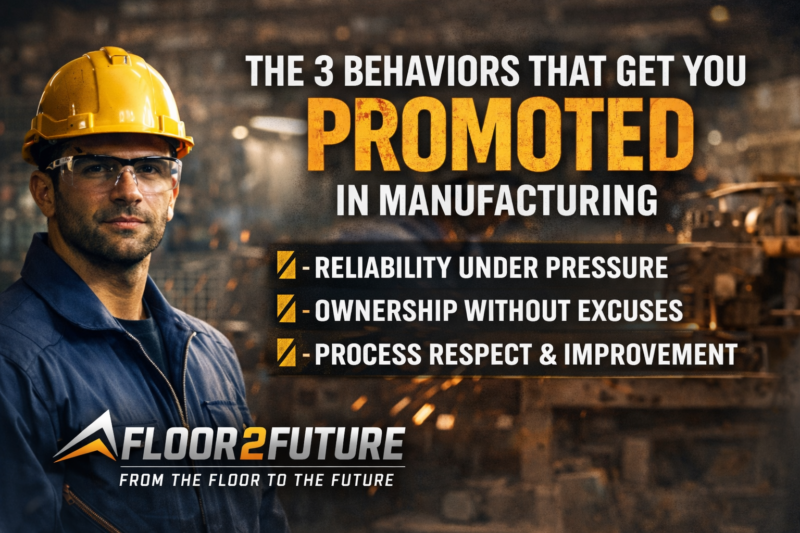
The article, titled “The 3 Behaviors That Get You Promoted in Manufacturing,” outlines practical, behavior-based principles that supervisors consistently look for when identifying future leaders on the shop floor.

Cincinnati’s manufacturing sector spans aerospace, automotive, metal fabrication, advanced machining, and industrial production. While technical skills remain important, Floor2Future founder Sean [Last Name] emphasizes that behavioral consistency is often the true differentiator.

“Promotions in manufacturing aren’t random,” Sean said. “In plants across the Cincinnati region, supervisors are watching patterns. They promote reliability, ownership, and respect for process.”

The article identifies three core behaviors that consistently separate promotable employees from the average workforce:

1. Reliability Under Pressure
Maintaining steady performance during tight production schedules and operational challenges.

2. Ownership Without Excuses
Taking responsibility for outcomes and solving problems without deflection.

3. Process Respect and Continuous Improvement
Understanding how quality, cost, and throughput impact the entire operation — not just one workstation.

With manufacturers across Southwest Ohio continuing to seek dependable, promotable talent, the article serves as both guidance for workers and insight for employers.

In addition to publishing workforce development content, Floor2Future provides free foundational training for candidates in areas such as:

  • Work Ethic fundamentals
  • Professional communication
  • Safety awareness
  • Workplace professionalism

“Manufacturing offers real upward mobility in Cincinnati,” Sean added. “But advancement comes from consistency, not intensity. We’re helping workers understand what actually gets them promoted.”

Floor2Future partners with regional manufacturers to connect disciplined, prepared candidates with long-term career opportunities while reinforcing professional standards that strengthen the local workforce.

career opportunities
Manufacturing Isn’t About Working Hard — Manufacturing Success Starts With Consistency

Let’s clear something up.

Manufacturing is not about breaking your back.
It’s not about being the toughest person in the room.
It’s not about exhausting yourself to prove something.

It’s about one thing:

Consistency.

And consistency beats raw effort every single time.


Stop Thinking “Hard Work.” Start Thinking “Relentless Discipline.”

Hard work is emotional.

Discipline is controlled.

Hard work burns people out.
Discipline builds careers.

Manufacturing rewards the person who:

  • Shows up on time — every time
  • Pays attention — every shift
  • Follows the process — every part
  • Protects quality — every order

You don’t need hero moments.

You need steady performance.


The Industry Is Watching

Supervisors notice patterns.

They see who drifts.
They see who complains.
They see who checks out early.

But they also see:

  • The operator who keeps the machine running
  • The team member who fixes small problems before they grow
  • The person who doesn’t make excuses

That person moves up.

Not because they “worked harder.”

Because they were consistent when others weren’t.


The 80/20 Reality of Work Ethic

Here’s the truth most people miss:

20% of employees carry 80% of the reliability.

If you choose to be in that 20%, you don’t need to chase opportunity.

Raises.
Cross-training.
Leadership roles.
Better shifts.

They come to you.

Consistency puts you in the top tier.


And You Don’t Have to Do It Alone

When you work with Floor2Future, you’re not just getting placed into a job.

You’re getting an edge.

We provide free training along the way, including:

  • Work Ethic fundamentals
  • Professional communication basics
  • Safety awareness
  • Body language in the workplace

These aren’t just “courses.”

They are competitive advantages.

Most people show up to work hoping to figure it out.

Our candidates show up prepared.


You Don’t Need Talent. You Need Standards.

You don’t have to know everything.

You don’t have to be the fastest.

You don’t have to be the most experienced.

But you do need standards:

  • No excuses
  • No shortcuts
  • No “good enough” mentality
  • No clock-watching mindset

Bring steady effort.
Protect your reputation.
Improve a little every week.

That’s how real careers are built in manufacturing.


From the Floor to the Future

If you want more than just a paycheck…

If you want upward movement…

If you want to build something real…

Then commit to consistency.

We’ll help you build the skills.

You bring the discipline.

That’s how you move from the floor to the future.


Ready to Separate Yourself From the Average?

If you’re serious about building a career in manufacturing — not just collecting a paycheck — take the next step.

When you work with Floor2Future, you don’t just get placed into a position.

You get:

  • Free foundational training
  • A structured path for growth
  • Ongoing career support
  • Access to companies that value discipline and reliability

Most people apply for jobs.

Our candidates prepare for careers.

Apply today and start building your future.

consulting services manufacturing
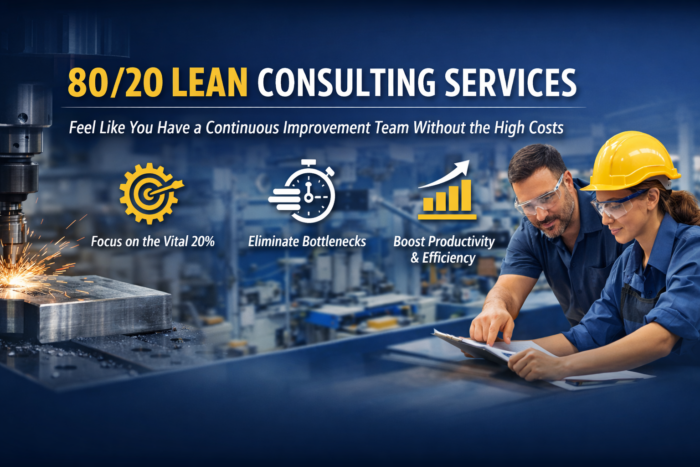
Introducing 80/20 Lean Consulting Services

Continuous Improvement Without the Continuous Improvement Payroll

Manufacturing companies don’t struggle because they lack effort.

They struggle because they’re focused on too many things at once.

For decades, large corporations have relied on dedicated continuous improvement teams — Lean managers, Black Belts, process engineers — all focused on driving operational efficiency.

But what about small to mid-sized manufacturers?

What about the companies that can’t justify a full-time CI department… yet still need results?

That’s exactly why we are launching 80/20 Lean Consulting Services.


The Problem Most Manufacturers Face

If you walk the floor of most shops, you’ll see:

  • Machines waiting on material
  • Operators waiting on instructions
  • Work-in-progress stacking up
  • Accounting frustrated with margin compression
  • Leadership reacting instead of leading

Everyone is working hard.

But the effort is scattered.

The truth is simple:
80% of operational pain usually comes from 20% of the processes.

Yet most improvement efforts try to fix everything at once.

That’s expensive.
That’s slow.
And that’s why many Lean initiatives fade away.


The 80/20 Lean Approach

Our consulting services are built around one core principle:

Identify the vital few that drive the majority of results.

We don’t start with theory.
We start with:

  • Throughput history
  • Bottleneck analysis
  • Financial pain points
  • Floor observation
  • Constraint movement

We identify the top one or two bottlenecks.

Then we calculate:

  • How much time must be reduced to move the constraint
  • What that time reduction is worth in revenue
  • What that bottleneck is costing per hour, per shift, per month

This turns improvement into a financial conversation — not just an operational one.


Designed for Small to Mid-Sized Manufacturers

This service is ideal for companies that want to feel like they have a continuous improvement team — without carrying the full-time payroll of one.

Instead of hiring:

  • A Lean Manager
  • A Process Engineer
  • A Six Sigma Black Belt

You gain focused, strategic guidance aimed directly at the highest-impact areas.

Not 50 initiatives.

Not “flavor of the month” programs.

Just the vital few.


What You Can Expect

With 80/20 Lean Consulting, companies typically gain:

  • Improved throughput without major capital investment
  • Reduced bottleneck stagnation
  • Clear alignment between operations and accounting
  • Stronger leadership clarity
  • Faster implementation cycles

This is not theory-based Lean.

This is floor-driven Lean.


Continuous Improvement Shouldn’t Be a Luxury

Continuous improvement should not be reserved for Fortune 500 companies.

It should be accessible, practical, and measurable for every manufacturer.

That’s what this launch represents.

A simpler path.
A sharper focus.
A disciplined application of the 80/20 principle inside manufacturing operations.


Ready to Get Started?

If you’re a manufacturer who:

  • Feels stuck in reactive mode
  • Knows there’s waste but can’t pinpoint it
  • Wants measurable results without adding overhead
  • Wants to align operations with profitability

We should talk.

The 80/20 Lean Consulting Services are now live.

Let’s identify your vital few — and move your constraint forward.

best project management system
Why Task27 Is a Strategic Expansion of the Floor2Future Ecosystem

At Floor2Future.com, we have never viewed recruiting, training, and leadership development as isolated services.

They are systems.

And systems require structure.

That’s why we are expanding our digital ecosystem with the integration of Task27, our premier project management platform designed to strengthen execution across recruiting, training, operational improvement, and upcoming franchise territories.

This is not about adding software.

It’s about reinforcing infrastructure.


From Services to Systems

Floor2Future was built around one core belief:

Impacting companies and careers requires structure, accountability, and disciplined execution.

We help companies:

  • Recruit the right people
  • Train them effectively
  • Develop strong leaders
  • Improve operational performance

But delivering these services at scale demands more than expertise. It demands coordination.

Task27 provides that coordination.

Instead of relying on disconnected tools, scattered emails, or spreadsheet tracking, Task27 centralizes:

  • Project workflows
  • Recruiting milestones
  • Training rollouts
  • Leadership initiatives
  • Client engagements

Everything moves through one organized system.


Why Project Management Matters in Workforce Development

Recruiting is not just interviews.

Training is not just content.

Leadership development is not just instruction.

Each of these requires timelines, accountability, communication, and measurable execution.

Task27 gives Floor2Future the ability to:

  • Track recruiting pipelines with structure
  • Coordinate onboarding programs
  • Manage custom training deployments
  • Monitor leadership implementation plans
  • Maintain visibility across teams

This ensures clients experience consistency, not chaos.


A Franchise-Ready Foundation

As Floor2Future prepares for upcoming franchise availability, systemization becomes critical.

Franchise growth only works when processes are standardized.

Task27 serves as the operational backbone for future franchise partners by providing:

  • Defined workflows
  • Clear task ownership
  • Transparent communication
  • Measurable accountability
  • Unified operational standards

Rather than each territory improvising its own systems, franchise owners will operate within a structured, proven framework.

That structure protects brand integrity and increases the likelihood of long-term success.


Discipline Over Noise

The market is crowded with enterprise software that promises everything.

Task27 focuses on execution.

It is clean.
It is practical.
It is built for accountability.

It reinforces our philosophy that operational clarity beats complexity.


Building for Long-Term Impact

Floor2Future is expanding intentionally.

Recruiting.
Training.
Leadership development.
Operational improvement.

Now strengthened by structured project management infrastructure.

Task27 represents the next step in building a scalable ecosystem capable of impacting companies and careers at a national level.

As we move toward franchise expansion, this investment in digital systems ensures that growth will be disciplined, measurable, and aligned with our mission.

The future of workforce development is not fragmented.

It is structured.

And Task27 is part of that foundation.

Why Modern Manufacturing Needs a Bottom-Up Workforce Model

Modern manufacturing is in the middle of a paradox. Investment is rising, technology is accelerating, and the need for skilled production talent has never been higher—yet many manufacturers still struggle to fill roles, stabilize teams, and build a pipeline that lasts.

The reason isn’t mysterious. The “skills gap” is real, but it’s not just about CNC, PLCs, metrology, or blueprint reading. It’s also about retention, expectations, leadership depth, and whether workers see a future in the work—or just another short stop on the road to somewhere else.

That’s the backdrop for Floor2Future.com: a platform designed to strengthen manufacturing from the ground up by developing stronger contributors, building better team leads, and creating clearer career pathways that benefit both people and companies.

The Pressure Is Rising: Open Roles and a Shrinking Pipeline

Manufacturers across the U.S. are facing a widening workforce shortfall. The National Association of Manufacturers has highlighted that the U.S. could face a shortfall of 1.9 million manufacturing workers by 2033, with 3.8 million positions expected to open and nearly half potentially going unfilled—despite manufacturing offering strong total compensation.

That statistic matters because it reframes the conversation. This isn’t a “recruiting problem” solved by posting more jobs. It’s a structural pipeline issue involving retirements, growth, competition for talent, and the increasing complexity of manufacturing work.

At the same time, technology is changing what “qualified” even means. Automation, advanced inspection, digital work instructions, and data-driven process control are elevating expectations at the operator level. Hiring managers increasingly need candidates who can learn quickly, adapt, communicate, and take ownership—not just show up.

The Skills Gap Is Also a Mindset and Leadership Gap

One of the biggest misconceptions in workforce development is that the gap can be solved by technical training alone. A credential helps—but it doesn’t automatically create reliability, judgment, communication, or pride in workmanship.

Multiple credible sources point to this broader shift in skill requirements. A World Economic Forum theme across its workforce work is that a large portion of skills are expected to change over a short time horizon; Deloitte’s workforce analysis cites the WEF’s findings that substantial skill requirements will evolve as advanced manufacturing transforms.

In plain terms: even if you train someone today, the job they do two years from now may require a different mix of technical ability, digital comfort, and soft skills. That means the workforce solution must be designed for ongoing development, not one-and-done orientation.

Why Retention Breaks the System (Even When Hiring “Works”)

Let’s say a company does manage to hire. If turnover stays high, the system never stabilizes:

  • Training becomes constant re-training
  • tribal knowledge leaks out the door
  • quality suffers under churn
  • supervisors spend their time “patching holes” instead of improving process
  • top performers burn out from carrying the load

This is why workforce development has to connect directly to daily behaviors: accountability, attendance, standard work discipline, problem escalation, and teamwork. If those fundamentals don’t improve, the revolving door wins—no matter how many ads you run.

Even manufacturer sentiment surveys reflect how persistent workforce difficulty remains as a business constraint. The National Association of Manufacturers Manufacturers’ Outlook Survey has consistently tracked workforce attraction and retention as a major concern for manufacturers in recent years.

The “Bottom-Up” Solution: Start Where the Work Happens

Manufacturing performance is ultimately created at the point of execution: the cell, the line, the machine, the inspection bench, the material flow lane. Yet most workforce strategies overemphasize top-down elements (policies, compensation structures, job postings) and underemphasize the bottom-up drivers (skill-building, pride, leadership habits, and shop-floor communication).

A bottom-up workforce model focuses on:

  1. Operator readiness as a core business lever
    Not just “filled seats,” but people who can meet the moment: safe work, consistent output, quality awareness, and continuous improvement participation.
  2. Clear expectations and personal standards
    Many failures are expectation failures. A bottom-up approach makes success requirements obvious early—before bad habits become culture.
  3. Leadership development at the first rung
    Companies promote their best technical people into lead roles and hope it works out. Often, they don’t get the structure or coaching needed to lead consistently. Building strong team leads is one of the highest-leverage moves a plant can make.
  4. Career pathways that feel real
    When employees can see the ladder—and believe it’s attainable—they stay longer, learn faster, and contribute more. The alternative is “job hopping” as the default path to pay growth.

Where Floor2Future Fits: Workforce Development That Serves Both Sides

Floor2Future.com is built to align incentives for both workers and manufacturers:

  • For workers: a clearer path from entry-level to advanced responsibility, plus development in the skills that actually unlock promotions—reliability, communication, leadership behavior, and continuous improvement thinking.
  • For companies: a pipeline of candidates who are more prepared for real production environments, and a framework that supports retention and stability—not just hiring volume.

This is also where the model departs from traditional recruiting. Recruiting is often transactional: fill the job, move on. Workforce development is compounding: when you build capability and culture, performance improves month after month.

Digital Real Estate That Supports the Mission

A strong workforce model needs infrastructure—places where people can enter the ecosystem, learn what’s expected, and connect with opportunities. That’s one reason Road2Jobs.com exists: as a focused platform supporting manufacturing roles while reinforcing the broader goal of improving readiness and fit, not just “applications per posting.”

Digital real estate matters because attention is fragmented. Workers search across multiple platforms; employers do the same. Owning a purpose-built entry point makes it possible to build consistency—consistent messaging, consistent expectations, consistent development pathways.

The Big Opportunity: Rebuilding Trust Between Employers and Workers

If you zoom out, the manufacturing workforce challenge is partly a trust challenge.

  • Employers worry about attendance, engagement, and dependability.
  • Workers worry about instability, burnout, and lack of growth.

A bottom-up approach rebuilds trust through performance and clarity:

  • workers know what great looks like and how to earn more responsibility
  • employers get people who understand the job and take pride in execution
  • leadership becomes more consistent and less reactive

That’s how you improve the “landscape” of modern manufacturing—not with hype, but with systems that make success more likely.

Where This Goes Next

The manufacturers who win the next decade won’t just buy better machines. They’ll build better people systems—where capability grows, leadership is trained, and shop-floor execution becomes a competitive advantage.

That’s the aim of Floor2Future: to help create manufacturing careers that last, and manufacturing businesses that can scale without being held hostage by turnover and talent shortages.

If you’re a manufacturer trying to stabilize performance—or a worker looking to build a real career path—Floor2Future is designed to be a practical bridge between today’s needs and the future you’re trying to reach.

Road2Jobs.com: Building a Stronger Pathway Into Modern Manufacturing

The manufacturing industry is evolving faster than ever—driven by technology, automation, and shifting workforce expectations. Yet one critical area continues to lag behind: how people enter, navigate, and grow within manufacturing careers. At Floor2Future.com, we believe that solving this challenge requires more than traditional recruiting or job postings. It requires a connected ecosystem built around preparation, expectations, and long-term success.

That belief is what led to the creation of Road2Jobs.com.

The Floor2Future Model: More Than Placement

Floor2Future.com was built on a simple but often overlooked principle: strong manufacturing companies are built by developing people, not just filling positions. Our model integrates workforce development, training, and career-long support to help individuals become reliable contributors and future leaders—while helping manufacturers reduce turnover, improve performance, and build stability.

Rather than operating as a traditional recruiting firm, Floor2Future focuses on alignment. We work to ensure individuals understand what modern manufacturing demands, and that companies receive candidates who are motivated to build careers, not just collect paychecks.

Road2Jobs.com exists as a critical extension of that model.

What Road2Jobs.com Is Designed to Do

Road2Jobs.com is a workforce-focused digital platform dedicated specifically to manufacturing roles. It is not a generic job board. It is purpose-built to improve how people connect with manufacturing opportunities—and how manufacturers identify talent that fits both technically and culturally.

The platform emphasizes:

  • Clear expectations about manufacturing environments
  • Career pathways rather than one-off placements
  • Workforce readiness and mindset, not just resumes

By reframing how jobs are presented and how candidates engage, Road2Jobs.com helps raise the overall quality of the hiring conversation on both sides.

Improving the Manufacturing Landscape

Modern manufacturing faces well-documented challenges: skills gaps, high turnover, inconsistent training, and misalignment between employers and workers. Road2Jobs.com is designed to address these issues upstream—before they become costly problems on the shop floor.

For manufacturers, this means:

  • Reduced hiring friction
  • Better alignment between role requirements and candidate expectations
  • Access to individuals who see manufacturing as a career, not a stopgap

For individuals, it means:

  • A clearer entry point into manufacturing
  • Greater visibility into long-term growth opportunities
  • Support from an ecosystem invested in their success

This approach benefits the entire industry by improving retention, engagement, and long-term workforce stability.

Digital Real Estate With Strategic Purpose

Road2Jobs.com is owned and operated by Floor2Future.com as part of a broader workforce ecosystem. As digital real estate, it serves a specific strategic role: creating a focused, industry-specific gateway that connects talent, training, and opportunity under one unified vision.

By owning and operating this platform, Floor2Future ensures that workforce development remains intentional, values-driven, and aligned with real manufacturing needs—rather than dictated by volume-based recruiting models.

Looking Forward

The future of manufacturing depends on more than machines and technology—it depends on people who are prepared, motivated, and supported throughout their careers. Road2Jobs.com represents a step toward rebuilding that foundation by bringing clarity, structure, and purpose back into the workforce pipeline.

At Floor2Future.com, our mission remains the same: to impact companies and careers by developing strong contributors and leaders who can grow alongside the industry. Road2Jobs.com is one of the ways we are turning that mission into action.

manufacturing trends 2026
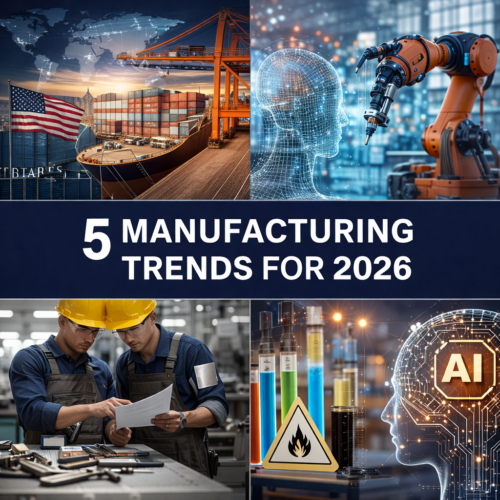
Five Manufacturing Trends to Watch in 2026

As the manufacturing sector moves into 2026, companies are adjusting to new economic pressures, emerging technologies, and ongoing workforce challenges. Several trends are shaping the industry’s trajectory this year, with implications for investment, operations, and strategic planning.

Trade and Tariff Uncertainty Continues to Influence Decisions
Manufacturers are still navigating the effects of shifting tariff policies and trade uncertainty, which have influenced production costs, sourcing strategies, and overall demand. Economic indicators at the end of 2025 showed manufacturing activity dipping, in part due to unclear trade policy and weak external demand, reflecting the industry’s sensitivity to tariff structures and global conditions. This uncertainty remains a key factor in planning and investment decisions for 2026.

Investment in Domestic Production and Advanced Sectors Remains Strong
Despite policy challenges, capital investments in domestic production are expanding. Demand for semiconductors, data center components, and other high-tech manufacturing continues to attract substantial investment, driven by both private commitments and public incentives. This trend underscores the ongoing focus on strengthening U.S. production capabilities and expanding capacity in key sectors.

Workforce Development and Skills Training Are Increasing Priorities
Finding qualified workers remains a persistent challenge. As manufacturers adopt more advanced technologies, including automation and digital tools, the need for a skilled workforce grows. Federal and state workforce development initiatives are ramping up support for training programs that align with in-demand industry needs. This focus on workforce transformation aims to close the skills gap and support long-term competitiveness.

AI and Automation Continue to Reshape Manufacturing Operations
Manufacturers are increasingly integrating artificial intelligence and automation into their operations to improve productivity, streamline processes, and reduce costs. These technologies are being deployed not just at the highest levels of production planning, but throughout shop floors to enhance quality control, predictive maintenance, and data analytics. As AI adoption expands, companies are betting that digital and smart manufacturing investments will be key drivers of future competitiveness.

Regulatory and Policy Dynamics Affect Industry Strategy
Shifts in environmental regulation and chemical policy are among the broader regulatory changes facing the industry in 2026. As agencies adjust rules and states enact new legislation, manufacturers must respond with compliance strategies that balance operational needs and regulatory requirements. These evolving frameworks influence production planning and long-term planning.

good manufacturing jobs.
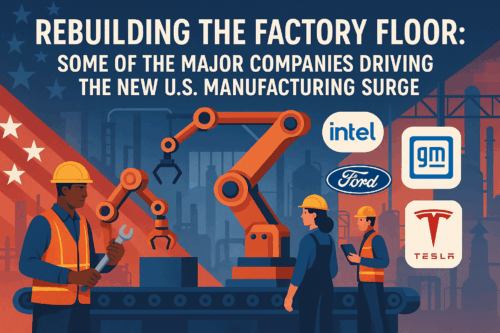
Rebuilding the Factory Floor: Some of the Major Companies Driving the New U.S. Manufacturing Surge!

    Short version: there is a ton of new money and jobs pouring into U.S. manufacturing right now—especially chips, EVs/batteries, and clean energy—but it’s uneven and still fighting against long-term job losses.

    1. The big picture: a manufacturing build-out

    • Between January and September 2025, companies announced over $1.2 trillion in investments to build out U.S. production capacity, led by electronics, pharmaceuticals, and semiconductors.
    • Factory construction spending has exploded: over the last year the U.S. has spent about $228 billion on manufacturing plants, with monthly spending running around $19 billion—up 219% from early 2021. Wolf Street+1
    • Reshoring + foreign direct investment (FDI) projects accounted for 244,000 announced manufacturing jobs in 2024 alone, with momentum still strong in early 2025. Reshoring Now

    So even though manufacturing employment is still below its late-1970s peak (the U.S. has lost about 6.6 million factory jobs since 1979), there’s clearly a new wave of plants and equipment going in. Federal Reserve Bank of Cleveland


    2. Semiconductors: CHIPS Act and the “fab boom”

    The biggest single story is chips.

    • As of mid-2025, companies have announced over $500 billion in private-sector commitments to build out the U.S. chip ecosystem, with the goal of tripling domestic capacity by 2032. Deloitte
    • The Semiconductor Industry Association estimates these projects will create/support 500,000+ U.S. jobs:
    • The lion’s share of CHIPS Act grants so far has gone to Intel, TSMC, Samsung, and Micron, tied to new fabs that are expected to add 30,000+ high-paying manufacturing jobs plus roughly 100,000 more construction and supplier jobs. LSA Technology Services+1

    On top of front-end fabs, you’ve now got Amkor building a massive advanced packaging campus in Peoria, Arizona—up to $7 billion investment and 3,000 jobs at full build-out, packaging chips for Apple and others. Tom’s Hardware

    For workers, that means demand not just for operators, but also:

    • Equipment and maintenance technicians
    • Process and quality techs
    • Facilities, utilities, and EHS roles
    • A big ring of construction and supplier jobs around the fabs

    3. EVs, batteries, and clean energy manufacturing

    The second big bucket is EV and clean-energy manufacturing, mostly boosted by the Inflation Reduction Act.

    • Over the last nine years, companies have announced $199 billion in U.S. EV and EV-battery investments, with 201,900 EV-related jobs already announced and the potential for up to 931,000 total jobs when you include the wider economy. Environmental Defense Fund+1
    • Hyundai + SK On and LG Energy Solution: two big EV/battery complexes in Georgia—near Atlanta and Savannah—totaling roughly $8–9 billion plus another $2 billion expansion, projected to create around 6,500 jobs. Climate Power
    • Stellantis + Samsung SDI (StarPlus Energy): two EV battery factories in Kokomo, Indiana, backed by a $7.54 billion federal loan, expected to create roughly 3,200 jobs. The Verge
    • A recent fact sheet on clean-energy manufacturing shows that August 2025 alone saw $2.4 billion in new clean-energy manufacturing investments and 3,700 new manufacturing jobs announced. Atlas Policy

    There is some turbulence—GM, for example, is cutting about 1,700 EV-related jobs and pausing some battery lines because demand isn’t ramping as fast as expected. Reuters+1
    But the overall trend is still a long pipeline of EV, battery, and component plants coming online over the next several years.

    On the ground, that means jobs for:

    • Battery and cell production operators
    • Assembly and testing techs
    • Automation/robotics maintenance
    • Materials handling and logistics

    4. Reshoring, appliances, and other “everyday” manufacturing

    It’s not just chips and EVs. A lot of traditional manufacturing is coming back or expanding as companies try to shorten supply chains and dodge tariffs.

    • A reshoring report finds that companies’ top reasons for bringing work back are:
      • Keeping manufacturing closer to engineering (45%)
      • Cutting freight and duty (45%)
      • Avoiding geopolitical risk (38%)
      • Staying close to customer markets (35%). AMT
    • GE Appliances (owned by Haier) just announced a $150 million investment in 22 U.S. suppliers across 10 states as part of a reshoring push. That’s tied into a broader $3 billion, five-year plan to modernize U.S. operations and expand a renovated Louisville, KY factory that will build new washer/washer-dryer lines starting in 2027. Suppliers are expanding plants, hiring staff, and buying new equipment to support this. Wall Street Journal
    • A reshoring analysis highlights four big players:
      • Newell Brands shifting consumer-goods manufacturing
      • Amkor (the AZ campus above)
      • Hyundai (EV and battery plants in Georgia)
      • Eli Lilly, which is pouring billions into new U.S. pharma manufacturing capacity. Tema ETFs
    • A White House investment roundup mentions Pratt Industries committing $5 billion to new paper/packaging plants, tied to 5,000 manufacturing jobs across Ohio, Michigan, Pennsylvania, and Arizona. The White House

    These projects create lots of the kinds of roles you care about in your own trainings:

    • Line operators and assemblers
    • Maintenance and toolroom roles
    • Quality inspectors and techs
    • Supervisors and production leads

    Exactly the types of people who can benefit from Lean / work-ethic / CNC / GD&T training.


    5. What this means for jobs and skills

    Putting the pieces together:

    • Capital is definitely coming back to U.S. manufacturing.
      Huge numbers like $1.2T in planned production investment and $228B/year in factory construction aren’t small moves. Global X ETFs+1
    • Job counts are big, but they’re “distributed” across construction, suppliers, and high-skill roles—not just straightforward line jobs.
    • Semiconductors + EV/batteries + clean energy are the big headline sectors, but reshoring in “boring” stuff (appliances, packaging, pharma, components) is quietly adding tens of thousands of jobs too. Reshoring Now+1
    • Skill bar is going up. A lot of these plants are highly automated. That makes foundational skills like:
      • Lean thinking and waste reduction
      • Strong work ethic and reliability
      • Basic CNC / mechatronics / GD&T
        even more valuable, because fewer people run more equipment.

    With the Floor2Future / Lean-Manufacturing-Specialist certification, you’re basically building training right in the middle of a multi-year build-out. Companies are going to need operators and front-line leaders who can step into these plants and actually keep them running efficiently. Floor2Future.com has its sights on being the doorway to this new era of manufacturing. We will be as dynamic as the industry needs us to be.

    Reclaiming the Work Ethic: How Manufacturing Rewards Hard Work—No Degree Needed

    In an era where digital fame and quick wins seem to dominate the headlines, there’s a quieter but steadfast narrative: the enduring value of a strong work ethic in manufacturing. This is a field where you don’t need a fancy degree to start. In fact, the education you need begins the moment you walk onto the shop floor. It’s a story of real opportunities and real rewards—built on dedication rather than diplomas.

    The Timeless Power of Hard Work

    For decades, manufacturing has offered a clear and accessible path to a stable career. Unlike many fields that demand years of formal education, manufacturing welcomes those who are ready to learn on the job. The moment you step into a factory, you start gaining the practical knowledge that turns you into a skilled specialist.

    This model isn’t new, but it’s as relevant as ever. In a world where the cost of higher education can be a barrier, manufacturing provides a different gateway. It says, “Show up, be reliable, and we’ll teach you everything you need to know.” The emphasis is on your willingness to work and learn, not on the credentials you bring with you.

    A Steady Path in an Uncertain World

    In today’s economy, many people are enticed by the idea of instant success. We hear stories of influencers and tech entrepreneurs who make it big overnight. But these stories, while inspiring, represent a tiny fraction of reality. For the vast majority, stable success comes from fields that offer reliability and a clear progression path.

    Manufacturing is one of those fields. It doesn’t promise instant fame, but it does promise a solid paycheck and job security. And unlike many careers that require expensive degrees, manufacturing lets you earn while you learn. The training you receive on the job is often all you need to advance.

    The Real Rewards of Effort

    What’s the payoff for this effort? It’s real and tangible. With a steady job in manufacturing, you can achieve many of the traditional markers of success: a comfortable home, a healthy savings account, and the ability to provide for your family. It’s a path paved with reliability, where hard work is rewarded with real, lasting benefits.

    Moreover, there’s the compound interest of time. The longer you stay in the field, the more your skills, experience, and earnings grow. This isn’t just about collecting a paycheck; it’s about building a future. Over time, you can move up the ranks, take on more responsibility, and increase your earning potential. And as you save and invest, you benefit from the steady growth that comes from long-term commitment.

    Conclusion: A Roadmap to Real Success

    In conclusion, the story of manufacturing is one of opportunity grounded in reality. It doesn’t rely on luck or viral fame. Instead, it offers a clear, stable path to success for those willing to put in the work. No degree is needed—just a willingness to learn, a commitment to show up, and a dedication to doing the job well.

    While the world changes around us, the value of a strong work ethic in manufacturing remains as powerful as ever. It’s a roadmap that has stood the test of time, offering real, lasting rewards to those who embrace it. In a world full of uncertainties, manufacturing remains a dependable and rewarding path to real success.

    The future of manufcturing
    The Future of Manufacturing: Lessons from 2025 and the Road Ahead

    If 2025 made one thing clear, it’s that the future of manufacturing isn’t just about cutting-edge innovation—it’s about being safer, smarter, and more connected. Over the past year, manufacturers navigated a rapidly changing landscape marked by labor shortages, supply chain volatility, and global uncertainty. In response, what were once considered long-term goals—like automation, system connectivity, and real-time data use—became critical components for day-to-day success.

    As the industry evolved, manufacturers discovered the power of blending advanced technology with a people-first approach. This synergy is now shaping how we define efficiency, safety, and workforce strategy.

    Here’s a breakdown of the most impactful trends from 2025—and how manufacturers can harness them to thrive in 2026 and beyond.


    Automation That Supports People and Safety

    Automation reached a new level of maturity in 2025, shifting from a “job replacement” narrative to a “workforce enabler” reality. Technologies such as Automated Guided Vehicles (AGVs), Autonomous Mobile Robots (AMRs), and Automated Storage and Retrieval Systems (AS/RS) played a major role in improving warehouse safety and efficiency.

    By taking over repetitive or hazardous tasks, these systems helped reduce injuries and burnout, allowing employees to focus on more meaningful, skill-based work in safer environments. This kind of smart automation not only increased productivity but also contributed to stronger workforce retention.

    Labor shortages remained a significant challenge throughout the year. The Bureau of Labor Statistics reported a manufacturing unemployment rate of 3.8% in August 2025—an 8.57% increase from the year prior. A Deloitte survey revealed that 65% of manufacturers ranked recruiting and retaining workers as their top concern. In response, many facilities embraced automation not just for output—but as a tool to attract and support their workforce.


    Balancing Innovation with Human Oversight

    While machines can handle much of the heavy lifting, human oversight remains irreplaceable. In 2025, manufacturers leaned into a model where human expertise and automated systems worked together to make better, faster decisions—especially in areas like quality control, safety, and troubleshooting.

    Facilities that succeeded didn’t automate for automation’s sake. Instead, they strategically integrated technology while redefining employee roles to maximize the strengths of both. This approach fostered collaboration between people and machines, leading to more agile and resilient operations.


    Driving Efficiency Through Interoperability

    Geopolitical instability in 2025 introduced new disruptions across global supply chains and trade networks. As economic volatility grew, the need for scalable, adaptable systems became more urgent.

    One standout solution? Interoperability.

    Rather than relying on isolated systems, manufacturers began integrating robots, sensors, software, and even charging infrastructure into unified ecosystems. These connected environments enabled real-time communication between technologies—boosting transparency across the supply chain and increasing flexibility on the production floor.

    This level of integration proved especially valuable for facilities operating under workforce constraints. Interoperable systems helped streamline cross-functional decision-making, reduce downtime, and enable a faster response to unforeseen challenges.


    The Rise of Data-Driven Manufacturing

    While data has always been a part of manufacturing, 2025 elevated it to a key competitive advantage. In an unpredictable economic climate, real-time analytics became essential for operational decision-making.

    Manufacturers leveraged data for everything—from optimizing shift schedules and monitoring equipment health to tracking workflow efficiency and ensuring safety compliance. Predictive insights also empowered teams to move from reactive to proactive strategies, anticipating issues before they impacted performance.

    As we move further into the digital age, data isn’t just a reporting tool—it’s a strategic asset that drives smarter planning, stronger safety, and better outcomes.


    What 2025 Taught Us—and What’s Next

    Ultimately, 2025 underscored that the most successful manufacturers are those who integrate innovation with intention. Safe, data-driven, and interoperable systems will define the next chapter of the industry—but only when paired with strong strategies and empowered people.

    Going forward, manufacturers must view their facilities as unified ecosystems—where automation and human talent work hand in hand to drive long-term success. That mindset will be key not just for surviving—but thriving—in 2026 and beyond.