
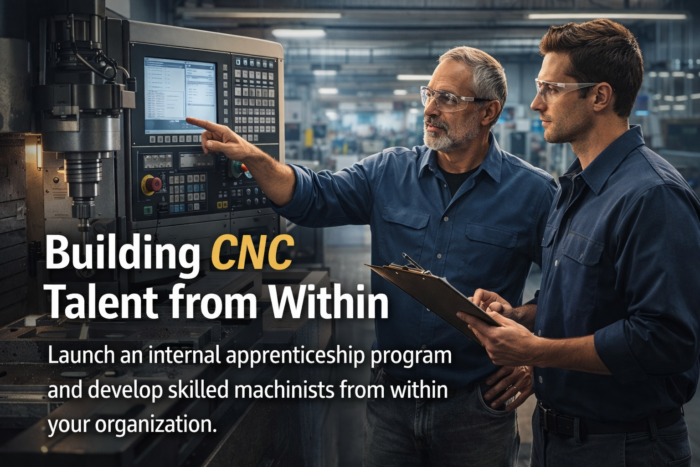
Building Talent From Within: Why More Manufacturers Need Internal CNC Apprenticeship Programs
One of the most persistent challenges facing modern manufacturing is not technology, automation, or even global competition. The challenge is people.
Across the industry, companies are struggling to find skilled machinists capable of operating CNC mills and lathes. Experienced programmers, setup technicians, and machinists are increasingly difficult to recruit, and when companies do find qualified candidates, the competition for that talent is intense.
The reality is simple: the external talent pool for skilled machining roles is extremely thin.
This situation has forced many manufacturing leaders to rethink a fundamental question:
What if the solution isn’t hiring talent from outside the organization, but developing it from within?
More companies are beginning to recognize that the most reliable way to build a strong workforce is by curating talent internally through structured apprenticeship programs.
The Shrinking Pool of Skilled Machinists
For decades, machining was a trade passed down through apprenticeship and hands-on training. Experienced machinists mentored younger operators, and skills were developed over time on the shop floor.
However, over the past twenty years, several factors have reduced the number of skilled machinists entering the workforce:
- Fewer vocational programs focused on machining
- A cultural shift away from skilled trades
- Retirements from the experienced manufacturing workforce
- Increasing technical complexity in CNC machining
At the same time, modern machining requires more skill than ever. Operators must understand tooling, offsets, inspection, feeds and speeds, program logic, and process control.
Simply hiring someone off the street and expecting them to succeed is rarely realistic.
The pipeline of experienced machinists simply isn’t large enough to support the industry’s demand.
Looking Inside the Organization
Many manufacturing facilities already have something extremely valuable inside their own walls: people who are capable of becoming skilled machinists.
These individuals may currently work in roles such as:
- secondary operations
- assembly
- machine tending
- inspection
- material handling
While they may not yet have machining expertise, many of them possess the most important qualities needed for success:
- strong work ethic
- reliability
- mechanical curiosity
- attention to detail
- commitment to the organization
These traits cannot easily be taught, but machining skills can.
That realization has led many companies to consider a more strategic approach to workforce development: internal apprenticeship programs.
The Concept of an Internal CNC Apprenticeship
An internal apprenticeship program allows companies to identify promising employees and gradually develop them into skilled machinists.
Rather than relying solely on outside hiring, organizations intentionally create a pipeline of talent that grows from within the business.
In a typical CNC apprenticeship program, selected employees move through several stages of development:
Stage 1: Machine Familiarization
Apprentices begin by learning the basics of machine operation, safety procedures, and shop fundamentals.
They observe experienced machinists and develop an understanding of the machining environment.
Stage 2: Machine Operation
At this stage, apprentices begin operating CNC machines under supervision. They learn basic tasks such as:
- loading parts
- monitoring cycle times
- checking dimensions
- understanding work instructions
This phase builds confidence and introduces them to the rhythm of production machining.
Stage 3: Setup and Tooling
As apprentices progress, they begin learning more advanced responsibilities, including:
- tool changes
- offsets
- workholding
- basic machine setup
This stage represents the transition from operator to technician.
Stage 4: Process Understanding
The final stage focuses on deeper process knowledge, including:
- reading programs
- understanding feeds and speeds
- troubleshooting machining issues
- maintaining process stability
By the end of this progression, the apprentice has developed the core skills required to operate and support CNC machining operations.
The Benefits of Developing Talent Internally
Companies that implement internal apprenticeship programs often discover several significant benefits.
1. Loyalty and Retention
Employees who are given opportunities to grow within an organization tend to develop stronger loyalty to the company.
When workers see a clear path for advancement, they become more invested in their careers and in the success of the organization.
2. Cultural Strength
Promoting from within reinforces a positive culture where employees understand that hard work and dedication are recognized.
This encourages others in the organization to develop their skills as well.
3. Operational Stability
External hiring always carries uncertainty. New hires must adapt to company culture, processes, and expectations.
Internal apprentices already understand the organization. They know the people, the systems, and the workflow.
This makes their transition into skilled roles smoother and more predictable.
4. Long-Term Workforce Sustainability
Perhaps most importantly, apprenticeship programs create a continuous talent pipeline.
Instead of scrambling to fill roles when experienced machinists retire or move on, companies maintain a steady flow of trained personnel ready to step into more advanced roles.
A Strategy More Manufacturers Should Consider
The manufacturing industry is entering a period where workforce development will become one of the most critical leadership responsibilities.
Technology will continue to advance. Machines will become faster, more precise, and more automated.
But the need for skilled people who understand the process will never disappear.
Organizations that rely solely on hiring from the outside will continue to struggle in a shrinking labor market.
Companies that invest in developing their own talent will build stronger, more resilient teams.
Internal apprenticeship programs represent one of the most practical ways to accomplish this.
By identifying motivated employees and giving them the opportunity to grow into skilled machinists, manufacturers can address one of the industry’s most pressing challenges while simultaneously strengthening their culture and workforce.
The talent may already be inside the building.
It simply needs the opportunity to be developed.