
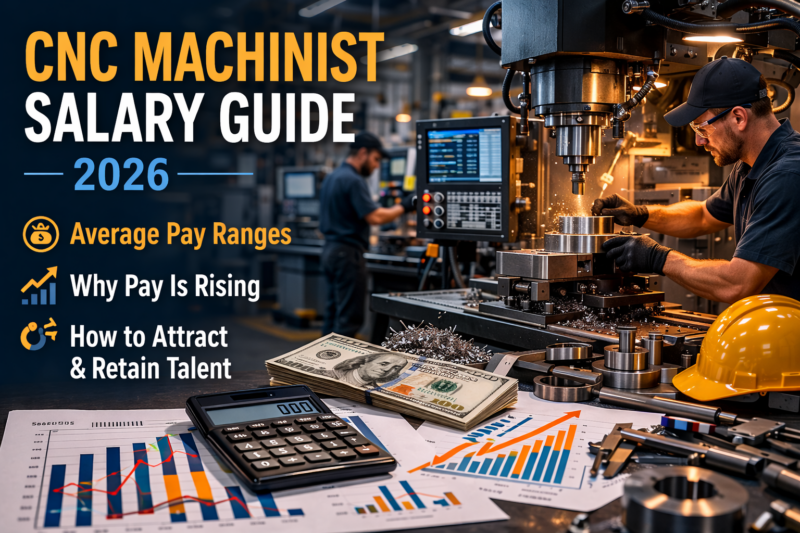
CNC Machinist Salary Guide (2026): What Manufacturers Must Pay to Hire and Keep Skilled Machinists
Across the manufacturing industry, one challenge continues to dominate conversations among plant managers, operations leaders, and HR professionals:
Finding skilled CNC machinists has become increasingly difficult.
Many manufacturers now find themselves competing for the same limited pool of experienced machinists capable of running CNC mills, lathes, and multi-axis machining centers. There is without a doubt a Machinist Shortage. Open roles often remain unfilled for months, and when qualified candidates appear, they frequently receive multiple offers.
One of the biggest drivers behind this challenge is rapidly changing wage expectations in the machining workforce.
Understanding what machinists are being paid—and why those wages are increasing—is essential for manufacturers who want to attract and retain skilled talent.
This guide provides a practical overview of CNC machinist salary ranges and explains what manufacturers must consider when building a competitive workforce strategy.
Average CNC Machinist Salaries in 2026
While pay varies by region, experience level, and industry specialization, CNC machinist wages have increased steadily across North America over the past several years.
Below are general salary ranges manufacturers are seeing in today’s labor market.
CNC Machine Operator
Typical Range: $20 – $28 per hour
These roles typically focus on running existing programs and performing basic production tasks such as loading parts, monitoring cycle times, and checking dimensions.
Operators often represent the entry point into machining careers.
CNC Machinist
Typical Range: $25 – $35 per hour
Machinists generally possess deeper technical knowledge and can perform tasks such as:
• adjusting offsets
• performing tool changes
• interpreting blueprints
• maintaining process stability
Many machinists are capable of troubleshooting machining issues during production.
CNC Setup Machinist
Typical Range: $30 – $40 per hour
Setup machinists are among the most valuable employees in a machining environment.
These professionals are responsible for:
• preparing machines for new jobs
• selecting tooling
• setting work offsets
• verifying part quality
• ensuring processes run efficiently
Because setup machinists have a combination of technical skill and production responsibility, demand for these workers is extremely high.
CNC Programmer
Typical Range: $35 – $50+ per hour
CNC programmers develop and optimize the programs used to manufacture parts.
Their responsibilities often include:
• writing and modifying G-code
• CAM programming
• toolpath optimization
• cycle time improvement
• troubleshooting complex machining challenges
Highly experienced programmers working with multi-axis equipment or complex aerospace components can earn significantly more.
Why Machinist Wages Are Increasing
Several long-term trends are pushing machinist wages upward.
Understanding these trends helps explain why manufacturers are struggling to fill open positions.
1. Retirement of Experienced Machinists
Many machinists currently working in the industry entered the trade decades ago during major manufacturing expansions.
As these workers approach retirement age, companies are losing decades of experience from the workforce.
Replacing that level of skill and knowledge is extremely difficult.
2. Declining Trade Education
Over the past twenty years, many vocational training programs focused on machining have disappeared from high schools and technical schools.
Students were increasingly encouraged to pursue four-year college degrees rather than skilled trades.
As a result, fewer young workers entered the machining profession.
The pipeline of new machinists began shrinking long before the industry fully recognized the consequences.
3. Increasing Technical Complexity
Modern machining environments are far more sophisticated than those of previous decades.
Machinists today must understand:
• blueprint reading
• inspection techniques
• tooling strategy
• feeds and speeds
• program logic
• process stability
Many machining roles now require both mechanical skill and technical understanding.
The increased complexity raises the skill threshold required to succeed in the field.
The Hidden Cost of Machinist Turnover
Many manufacturers underestimate the true cost of losing skilled machinists.
Replacing experienced employees often involves:
• recruiting costs
• lost production during vacancies
• training time for new hires
• reduced productivity during onboarding
Even when a new machinist is hired quickly, it can take months before they reach full productivity within a new shop environment.
For this reason, retention and workforce development are becoming increasingly important for manufacturing leaders.
Why Recruiting Alone Won’t Solve the Problem
Many companies attempt to address the machinist shortage by increasing wages and expanding recruiting efforts.
While competitive wages are important, recruiting alone cannot solve the underlying workforce problem.
The core issue is that the supply of skilled machinists is smaller than the industry demand.
When every manufacturer is competing for the same limited group of experienced machinists, recruiting becomes a constant battle.
This reality is forcing many organizations to rethink how they develop talent.
The Smarter Strategy: Develop Talent From Within
An increasing number of manufacturers are beginning to focus on developing machining talent internally.
Many facilities already have employees with the qualities required to become skilled machinists.
These individuals often work in roles such as:
• machine tending
• assembly
• secondary operations
• inspection
While they may not yet possess machining skills, many demonstrate the most important characteristics required for success:
• strong work ethic
• reliability
• attention to detail
• curiosity about machines and processes
These qualities are difficult to teach, but machining skills can be developed.
By creating internal apprenticeship programs and structured training paths, companies can build their own pipeline of machinists.
Combining Hands-On Training with Structured Learning
Successful workforce development programs often combine hands-on machining experience with structured learning.
Apprentices gain real-world experience operating machines while also developing foundational knowledge through training.
This structured approach helps employees understand:
• machining fundamentals
• measurement techniques
• tooling concepts
• process stability
The combination of hands-on experience and knowledge development accelerates skill growth.
The Future of the Machining Workforce
The machinist shortage is unlikely to disappear anytime soon.
Manufacturers who rely solely on hiring experienced machinists will continue facing significant workforce challenges.
Companies that invest in developing their own talent pipelines will be better positioned to maintain stable operations and support future growth.
The next generation of machinists may already be working inside many manufacturing facilities.
They simply need the opportunity—and the training—to develop their skills.
How Floor2Future Helps Manufacturers Solve Workforce Challenges
Floor2Future helps manufacturing organizations address workforce challenges through a combination of recruiting, training, and apprenticeship program development.
Services include:
• recruiting manufacturing talent
• designing CNC apprenticeship programs
• creating structured machining training systems
• implementing online training modules and knowledge testing
By combining hands-on training with structured development systems, manufacturers can build sustainable talent pipelines that strengthen their workforce.
To learn more about developing the next generation of machinists, visit:
Floor2Future.com