
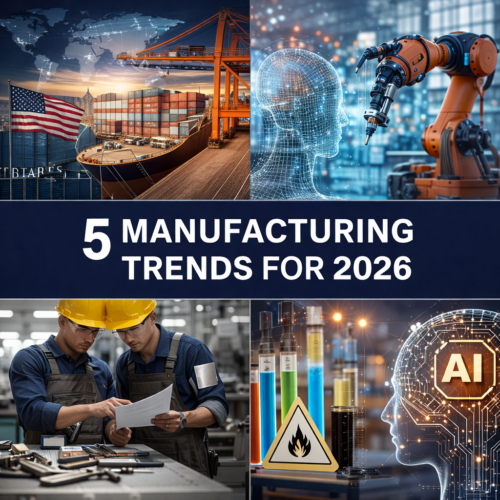
Five Manufacturing Trends to Watch in 2026
As the manufacturing sector moves into 2026, companies are adjusting to new economic pressures, emerging technologies, and ongoing workforce challenges. Several trends are shaping the industry’s trajectory this year, with implications for investment, operations, and strategic planning.
Trade and Tariff Uncertainty Continues to Influence Decisions
Manufacturers are still navigating the effects of shifting tariff policies and trade uncertainty, which have influenced production costs, sourcing strategies, and overall demand. Economic indicators at the end of 2025 showed manufacturing activity dipping, in part due to unclear trade policy and weak external demand, reflecting the industry’s sensitivity to tariff structures and global conditions. This uncertainty remains a key factor in planning and investment decisions for 2026.
Investment in Domestic Production and Advanced Sectors Remains Strong
Despite policy challenges, capital investments in domestic production are expanding. Demand for semiconductors, data center components, and other high-tech manufacturing continues to attract substantial investment, driven by both private commitments and public incentives. This trend underscores the ongoing focus on strengthening U.S. production capabilities and expanding capacity in key sectors.
Workforce Development and Skills Training Are Increasing Priorities
Finding qualified workers remains a persistent challenge. As manufacturers adopt more advanced technologies, including automation and digital tools, the need for a skilled workforce grows. Federal and state workforce development initiatives are ramping up support for training programs that align with in-demand industry needs. This focus on workforce transformation aims to close the skills gap and support long-term competitiveness.
AI and Automation Continue to Reshape Manufacturing Operations
Manufacturers are increasingly integrating artificial intelligence and automation into their operations to improve productivity, streamline processes, and reduce costs. These technologies are being deployed not just at the highest levels of production planning, but throughout shop floors to enhance quality control, predictive maintenance, and data analytics. As AI adoption expands, companies are betting that digital and smart manufacturing investments will be key drivers of future competitiveness.
Regulatory and Policy Dynamics Affect Industry Strategy
Shifts in environmental regulation and chemical policy are among the broader regulatory changes facing the industry in 2026. As agencies adjust rules and states enact new legislation, manufacturers must respond with compliance strategies that balance operational needs and regulatory requirements. These evolving frameworks influence production planning and long-term planning.