Search for:
cnc salary range
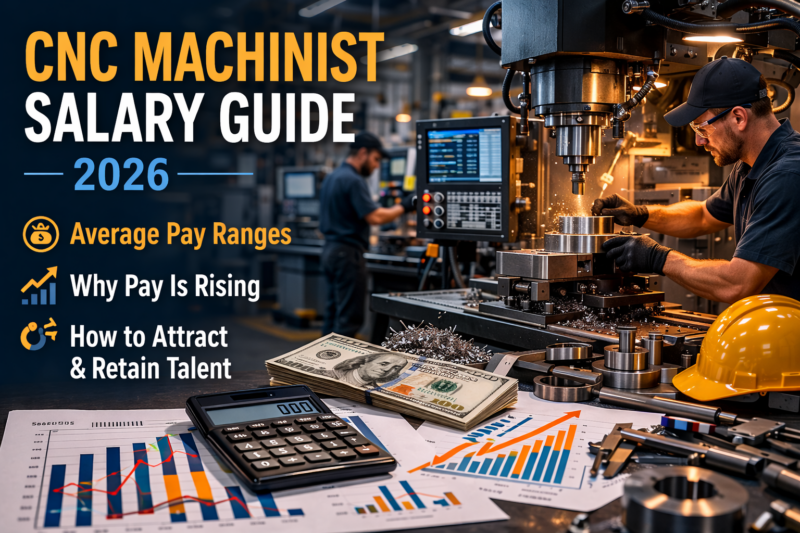
CNC Machinist Salary Guide (2026): What Manufacturers Must Pay to Hire and Keep Skilled Machinists

Across the manufacturing industry, one challenge continues to dominate conversations among plant managers, operations leaders, and HR professionals:

Finding skilled CNC machinists has become increasingly difficult.

Many manufacturers now find themselves competing for the same limited pool of experienced machinists capable of running CNC mills, lathes, and multi-axis machining centers. There is without a doubt a Machinist Shortage. Open roles often remain unfilled for months, and when qualified candidates appear, they frequently receive multiple offers.

One of the biggest drivers behind this challenge is rapidly changing wage expectations in the machining workforce.

Understanding what machinists are being paid—and why those wages are increasing—is essential for manufacturers who want to attract and retain skilled talent.

This guide provides a practical overview of CNC machinist salary ranges and explains what manufacturers must consider when building a competitive workforce strategy.


Average CNC Machinist Salaries in 2026

While pay varies by region, experience level, and industry specialization, CNC machinist wages have increased steadily across North America over the past several years.

Below are general salary ranges manufacturers are seeing in today’s labor market.

CNC Machine Operator

Typical Range: $20 – $28 per hour

These roles typically focus on running existing programs and performing basic production tasks such as loading parts, monitoring cycle times, and checking dimensions.

Operators often represent the entry point into machining careers.


CNC Machinist

Typical Range: $25 – $35 per hour

Machinists generally possess deeper technical knowledge and can perform tasks such as:

• adjusting offsets
• performing tool changes
• interpreting blueprints
• maintaining process stability

Many machinists are capable of troubleshooting machining issues during production.


CNC Setup Machinist

Typical Range: $30 – $40 per hour

Setup machinists are among the most valuable employees in a machining environment.

These professionals are responsible for:

• preparing machines for new jobs
• selecting tooling
• setting work offsets
• verifying part quality
• ensuring processes run efficiently

Because setup machinists have a combination of technical skill and production responsibility, demand for these workers is extremely high.


CNC Programmer

Typical Range: $35 – $50+ per hour

CNC programmers develop and optimize the programs used to manufacture parts.

Their responsibilities often include:

• writing and modifying G-code
• CAM programming
• toolpath optimization
• cycle time improvement
• troubleshooting complex machining challenges

Highly experienced programmers working with multi-axis equipment or complex aerospace components can earn significantly more.


Why Machinist Wages Are Increasing

Several long-term trends are pushing machinist wages upward.

Understanding these trends helps explain why manufacturers are struggling to fill open positions.


1. Retirement of Experienced Machinists

Many machinists currently working in the industry entered the trade decades ago during major manufacturing expansions.

As these workers approach retirement age, companies are losing decades of experience from the workforce.

Replacing that level of skill and knowledge is extremely difficult.


2. Declining Trade Education

Over the past twenty years, many vocational training programs focused on machining have disappeared from high schools and technical schools.

Students were increasingly encouraged to pursue four-year college degrees rather than skilled trades.

As a result, fewer young workers entered the machining profession.

The pipeline of new machinists began shrinking long before the industry fully recognized the consequences.


3. Increasing Technical Complexity

Modern machining environments are far more sophisticated than those of previous decades.

Machinists today must understand:

• blueprint reading
• inspection techniques
• tooling strategy
• feeds and speeds
• program logic
• process stability

Many machining roles now require both mechanical skill and technical understanding.

The increased complexity raises the skill threshold required to succeed in the field.


The Hidden Cost of Machinist Turnover

Many manufacturers underestimate the true cost of losing skilled machinists.

Replacing experienced employees often involves:

• recruiting costs
• lost production during vacancies
• training time for new hires
• reduced productivity during onboarding

Even when a new machinist is hired quickly, it can take months before they reach full productivity within a new shop environment.

For this reason, retention and workforce development are becoming increasingly important for manufacturing leaders.


Why Recruiting Alone Won’t Solve the Problem

Many companies attempt to address the machinist shortage by increasing wages and expanding recruiting efforts.

While competitive wages are important, recruiting alone cannot solve the underlying workforce problem.

The core issue is that the supply of skilled machinists is smaller than the industry demand.

When every manufacturer is competing for the same limited group of experienced machinists, recruiting becomes a constant battle.

This reality is forcing many organizations to rethink how they develop talent.


The Smarter Strategy: Develop Talent From Within

An increasing number of manufacturers are beginning to focus on developing machining talent internally.

Many facilities already have employees with the qualities required to become skilled machinists.

These individuals often work in roles such as:

• machine tending
• assembly
• secondary operations
• inspection

While they may not yet possess machining skills, many demonstrate the most important characteristics required for success:

• strong work ethic
• reliability
• attention to detail
• curiosity about machines and processes

These qualities are difficult to teach, but machining skills can be developed.

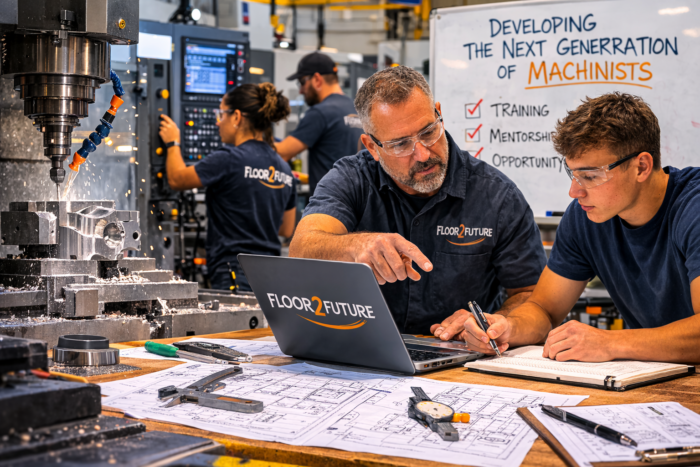
By creating internal apprenticeship programs and structured training paths, companies can build their own pipeline of machinists.


Combining Hands-On Training with Structured Learning

Successful workforce development programs often combine hands-on machining experience with structured learning.

Apprentices gain real-world experience operating machines while also developing foundational knowledge through training.

This structured approach helps employees understand:

• machining fundamentals
• measurement techniques
• tooling concepts
• process stability

The combination of hands-on experience and knowledge development accelerates skill growth.


The Future of the Machining Workforce

The machinist shortage is unlikely to disappear anytime soon.

Manufacturers who rely solely on hiring experienced machinists will continue facing significant workforce challenges.

Companies that invest in developing their own talent pipelines will be better positioned to maintain stable operations and support future growth.

The next generation of machinists may already be working inside many manufacturing facilities.

They simply need the opportunity—and the training—to develop their skills.


How Floor2Future Helps Manufacturers Solve Workforce Challenges

Floor2Future helps manufacturing organizations address workforce challenges through a combination of recruiting, training, and apprenticeship program development.

Services include:

• recruiting manufacturing talent
• designing CNC apprenticeship programs
• creating structured machining training systems
• implementing online training modules and knowledge testing

By combining hands-on training with structured development systems, manufacturers can build sustainable talent pipelines that strengthen their workforce.

To learn more about developing the next generation of machinists, visit:

Floor2Future.com

The Machinist Shortage: Why Manufacturers Can’t Find Skilled CNC Operators

Across the manufacturing industry, one problem continues to surface in conversations with plant managers, operations leaders, and manufacturing executives.

Companies are struggling to find skilled CNC machinists.

Facilities running CNC mills and lathes often have open positions that remain unfilled for months. When qualified candidates do appear, they are usually competing offers from multiple manufacturers looking to fill the same roles.

For many organizations, the talent pool feels almost nonexistent.

While it may appear to be a hiring problem on the surface, the machinist shortage is actually the result of several deeper trends that have been building for decades.

Understanding these trends is critical for manufacturers who want to develop a sustainable workforce strategy.


A Workforce That Is Aging Out

One of the largest contributors to the machinist shortage is the retirement of experienced workers.

Many skilled machinists entered the trade during the manufacturing expansion of the 1970s, 1980s, and 1990s. These individuals spent decades mastering their craft and became the backbone of machining operations across the industry.

Today, a large percentage of those machinists are reaching retirement age.

As they leave the workforce, they take decades of knowledge with them.

Unfortunately, the number of new machinists entering the trade has not kept pace with the number leaving it.

This creates a widening gap between the demand for skilled machinists and the available supply.


The Decline of Trade Training

Another factor contributing to the shortage is the decline of vocational training programs.

For many years, high schools and community colleges offered strong machining and trade programs that introduced students to manufacturing careers. These programs served as a pipeline that helped prepare young workers for careers as machinists.

Over time, many of these programs disappeared.

Educational systems began placing greater emphasis on four-year college paths, often at the expense of skilled trade education.

As a result, fewer students were exposed to machining as a career option.

The pipeline of entry-level machinists began shrinking long before the industry fully realized the impact.


Modern Machining Is More Complex

At the same time the workforce pipeline was shrinking, the technical complexity of machining was increasing.

Modern CNC machining requires more than simply running parts on a machine.

Operators and technicians must understand:

• blueprint reading
• measurement and inspection
• tooling and offsets
• feeds and speeds
• program logic
• process stability

Many machining roles now require a combination of technical skill, mechanical aptitude, and analytical thinking.

This raises the bar for new entrants into the field.

Companies are no longer just looking for machine operators. They are looking for individuals capable of managing increasingly sophisticated manufacturing processes.


The Competition for Skilled Machinists

Because the supply of skilled machinists is limited, companies are now competing heavily for experienced workers.

When a skilled machinist becomes available in the job market, multiple companies often pursue the same individual.

This leads to:

• higher recruiting costs
• wage escalation
• long vacancy periods for open positions

Even when a company successfully hires an experienced machinist, they must often compete to retain that employee.

Recruiting alone has become an increasingly difficult strategy for solving workforce challenges.


Why Hiring Alone Won’t Solve the Problem

Many manufacturers continue to approach the machinist shortage as a recruiting challenge.

They increase wages, expand job postings, and work with recruiting agencies to locate candidates.

While recruiting remains important, it cannot solve the underlying workforce issue by itself.

The fundamental problem is that the supply of skilled machinists is simply too small to meet industry demand.

When every company is competing for the same limited talent pool, recruiting becomes a zero-sum game.

One company may fill a role, but another company will still be left searching.

This reality is forcing more manufacturers to rethink how they develop their workforce.


Looking Inside the Organization

Many manufacturing facilities already have individuals capable of becoming skilled machinists.

These employees may currently work in roles such as:

• machine tending
• assembly
• secondary operations
• inspection
• material handling

While they may not yet possess machining experience, many already demonstrate the most important traits required for success.

These traits include:

• strong work ethic
• reliability
• attention to detail
• mechanical curiosity
• willingness to learn

These qualities cannot easily be taught.

But machining skills can.

When organizations begin viewing their workforce through this lens, they often discover that potential machinists are already inside their facility.

They simply need the opportunity to develop.


The Return of Apprenticeship Thinking

For decades, machining skills were traditionally developed through apprenticeship-style learning.

Experienced machinists mentored younger workers, gradually transferring knowledge and technical skill through hands-on experience.

While many companies moved away from formal apprenticeship models, the concept is now gaining renewed attention.

Internal apprenticeship programs allow manufacturers to create structured development paths that guide employees from entry-level roles into skilled machining positions.

Instead of hoping to recruit experienced machinists, companies can begin developing them internally.

This approach creates a sustainable talent pipeline that strengthens the organization over time.


Combining Hands-On Training with Structured Learning

One of the challenges of apprenticeship programs is ensuring that training is consistent and measurable.

Traditionally, training relied heavily on verbal instruction and informal mentoring. While mentorship remains extremely valuable, it can sometimes lead to inconsistent knowledge transfer.

Modern apprenticeship programs are increasingly combining hands-on shop floor training with structured learning systems.

Online training modules, knowledge testing, and development milestones allow companies to create clear learning paths for apprentices.

This ensures that employees not only gain practical experience but also build the technical knowledge required to succeed in machining roles.


The Future of the Manufacturing Workforce

The shortage of skilled machinists is not likely to disappear in the near future.

Manufacturers who rely solely on external hiring will continue to face increasing difficulty filling critical roles.

Organizations that begin developing their own talent pipelines will be better positioned to adapt to this changing workforce landscape.

By identifying motivated employees and creating structured development opportunities, companies can build the next generation of skilled machinists inside their own operations.

The future of manufacturing workforce development will depend not just on recruiting talent—but on cultivating it.


How Floor2Future Can Help

Floor2Future works with manufacturing organizations to address workforce challenges through a combination of recruiting support, apprenticeship program development, and structured training systems.

Through online training modules, testing systems, and apprenticeship frameworks, Floor2Future helps companies develop skilled machinists from within their workforce while strengthening long-term talent pipelines.

To learn more about building a sustainable manufacturing workforce, visit:

Floor2Future.com

New Book Release: The 80/20 Lean Field Manual Introduces a Simpler Approach to Manufacturing Improvement

Manufacturing companies across the world continue to search for better ways to improve productivity, quality, and operational efficiency. While Lean manufacturing has long been a cornerstone of continuous improvement, many organizations struggle with the complexity that often comes with large-scale Lean programs.

A new book, The 80/20 Lean Field Manual, aims to change that.

Written by manufacturing professional Sean Odell, the book introduces a practical and simplified approach to Lean manufacturing by applying one of the most powerful concepts in business: the 80/20 principle.


A Simpler Approach to Lean Manufacturing

The core idea behind the book is straightforward. In most manufacturing operations, a small number of problems create the majority of operational challenges. Rather than spreading improvement efforts across dozens of initiatives, The 80/20 Lean Field Manual encourages leaders to focus on the “vital few” issues that have the greatest impact on results.

By identifying and addressing these key problems, manufacturers can often achieve dramatic improvements in performance while reducing the complexity of their improvement programs.

The book is designed as a practical field guide, making it accessible not only for executives and engineers, but also for supervisors, team leaders, and operators working directly on the manufacturing floor.


Why Many Lean Programs Struggle

While Lean principles have transformed many organizations, the reality is that many improvement programs become overly complicated. Teams often spend significant time tracking metrics, running meetings, and launching multiple initiatives, yet struggle to see meaningful results.

The 80/20 Lean Field Manual challenges this approach by returning to a fundamental principle: not all problems are equal.

In most factories, a small number of operational constraints—bottlenecks, quality issues, or process inefficiencies—are responsible for a large percentage of lost productivity. By focusing attention on these critical areas, organizations can generate improvements that ripple throughout the entire operation.


Practical Lessons for Manufacturing Leaders

Throughout the book, readers learn how to:

  • Identify the most impactful operational problems in their facility
  • Avoid wasted effort on low-value improvement activities
  • Improve throughput and productivity by focusing on real constraints
  • Apply Lean thinking in a practical, floor-level way
  • Build a culture that prioritizes meaningful operational impact

Rather than presenting Lean as a complex system requiring large teams and extensive training, the book reframes it as a focused discipline centered on identifying and solving the problems that matter most.


A Tool for Today’s Manufacturing Environment

Modern manufacturing environments face increasing pressure to produce higher quality products, maintain tight cost control, and respond quickly to market changes. In this environment, improvement strategies must be both effective and efficient.

By combining Lean manufacturing principles with the 80/20 rule, The 80/20 Lean Field Manual offers a framework that helps organizations concentrate their efforts where they will produce the greatest results.


Now Available on Amazon

The 80/20 Lean Field Manual is now available for purchase on Amazon.

Manufacturing professionals interested in simplifying their improvement efforts and focusing on the most impactful operational opportunities can learn more about the book and how the 80/20 principle can transform Lean thinking.


About the Author

Sean Odell is a manufacturing professional with extensive experience in operations leadership, process improvement, and Lean manufacturing. Throughout his career, he has focused on identifying practical methods that help companies improve productivity, quality, and efficiency while keeping improvement efforts focused on the areas that deliver the greatest impact.

From Job to Career: Why Manufacturing Success Is About Mindset Before Skillset

When people think about success in manufacturing, they usually focus on skills: machine operation, blueprint reading, programming, quality inspection, or technical certifications. Skills matter—but they are not where success truly begins.

In reality, the biggest difference between someone who simply works a manufacturing job and someone who builds a long, lucrative career in precision manufacturing comes down to mindset.

Skillset gets you in the door.
Mindset determines how far you go.

The Skill Myth

There is a common misconception that manufacturing careers are only for people who already “know how to do it.” This belief discourages capable, motivated individuals from even considering the industry.

The truth is far simpler:
Most successful manufacturing professionals did not start with advanced skills.

They started with:

  • A willingness to learn
  • Consistency
  • Accountability
  • Pride in their work

Skills are teachable. Mindset is not—at least not easily.

Companies can train someone to run a CNC machine, inspect a part, or follow a process. What they cannot easily train is attitude, work ethic, or ownership.

That is why mindset always comes first.

What Employers Actually Look For

When manufacturers say, “We can’t find good people,” they are rarely talking about a lack of technical knowledge alone.

What they usually mean is:

  • People who show up late or inconsistently
  • People who do the minimum and stop
  • People who blame machines, supervisors, or processes instead of improving
  • People who treat the job as temporary—even when the opportunity is long-term

On the other hand, the individuals who advance quickly often share the same core traits:

  • They ask questions
  • They care about quality
  • They take responsibility when something goes wrong
  • They look for ways to improve instead of excuses

Those traits have nothing to do with skill level on day one.

Mindset Turns a Job Into a Career

A job is transactional.
A career is developmental.

People with a job mindset ask:

  • “What do I have to do today?”
  • “Is this my responsibility?”
  • “When does my shift end?”

People with a career mindset ask:

  • “How can I get better at this?”
  • “What’s the next role I could grow into?”
  • “What does this company need from me to trust me more?”

That difference compounds over time.

Two people can start on the same day, at the same machine, with the same pay. Five years later, one is still doing the same work, while the other has moved into setup, programming, quality, leadership, or engineering support.

The difference is not intelligence.
It is mindset.

Precision Manufacturing Rewards the Right Attitude

Precision manufacturing is not about rushing or cutting corners. It is about consistency, discipline, and attention to detail. These environments reward people who:

  • Take pride in accuracy
  • Respect standards and procedures
  • Understand the impact of their work downstream

This is why mindset matters even more in precision environments. One careless decision can cost thousands of dollars. One committed individual can prevent it.

People who approach their role with professionalism—even in entry-level positions—stand out quickly. Supervisors notice. Opportunities follow.

Why Skill Can Be Taught—but Mindset Cannot

Most manufacturing companies are willing to invest time and money into training people who show the right attitude. What they are unwilling to do is repeatedly invest in people who do not take the opportunity seriously.

This is why mindset is often the real hiring filter.

A candidate with limited experience but strong work ethic is often more valuable than a skilled candidate who lacks reliability, humility, or accountability.

That is not theory—it is lived experience across the industry.

The Floor2Future Philosophy

At Floor2Future, we believe manufacturing careers are built from the inside out.

That means:

  • Developing mindset before mastery
  • Teaching expectations before techniques
  • Preparing people not just to get hired—but to succeed

Floor2Future exists to help people move from the manufacturing floor to the future of their career by focusing on what truly drives long-term success.

We welcome individuals who may not have prior manufacturing experience but demonstrate:

  • A strong desire to learn
  • Respect for structure and standards
  • Pride in personal performance
  • Commitment to growth

Skills can follow. Careers can grow.

For Those Considering Manufacturing

If you are exploring manufacturing as a career path, ask yourself this:

  • Are you willing to learn?
  • Are you willing to be consistent?
  • Are you willing to take responsibility for your performance?

If the answer is yes, manufacturing can offer stability, strong income, advancement opportunities, and long-term growth—often without the burden of student debt.

Precision manufacturing rewards people who take it seriously.

For Those Already in the Industry

If you are already working in manufacturing, mindset is still the differentiator.

Advancement rarely comes from doing just enough. It comes from:

  • Being dependable
  • Solving problems instead of avoiding them
  • Taking ownership beyond your job description
  • Building trust through action

That is how careers are built—quietly, consistently, and over time.

Conclusion: Mindset Is the Foundation

Manufacturing does not need more people who are simply looking for a paycheck.

It needs people who are looking for a path.

Skill opens the door.
Mindset keeps it open.

Floor2Future exists to help rebuild the incredible opportunities of precision manufacturing—by connecting motivated people with careers that reward effort, growth, and professionalism.

If you are ready to move from a job mindset to a career mindset, the future is closer than you think.

Why Codie Sanchez Is One of the Most Important Voices in Modern Motivation

Motivation today is often shallow. Social media is full of hype, shortcuts, and promises of overnight success that don’t survive contact with reality. That’s why Codie Sanchez stands out so clearly in the noise.

Her message isn’t about escaping work.
It’s about owning value.

And that distinction matters.

Motivation Rooted in Reality

What makes Codie Sanchez compelling is not just her success—it’s how she frames success. She doesn’t sell fantasy lifestyles or passive income myths. Instead, she focuses on something far more powerful: boring businesses, real cash flow, and disciplined execution.

Her motivation lands because it’s grounded in truth:

  • Wealth is built, not wished for
  • Ownership matters more than optics
  • Consistency beats charisma
  • Most opportunity lives where most people refuse to look

That message resonates deeply with people who are tired of being told that success requires perfect timing, elite connections, or luck.

Contrarian Thinking That Actually Works

Codie’s philosophy challenges the modern obsession with startups, apps, and viral ideas. She repeatedly points people toward industries that are overlooked, unglamorous, and quietly profitable—laundromats, car washes, service businesses, and operational companies that have existed for decades.

Why is this motivating?

Because it reframes opportunity.

Instead of asking, “How do I compete with everyone else?”
She asks, “Where is nobody paying attention?”

That shift alone opens doors for people who thought success was out of reach.

Motivation Without Excuses

What separates Codie from many motivational figures is her intolerance for excuses—especially the socially acceptable ones.

She challenges:

  • The belief that college guarantees success
  • The idea that working harder is pointless
  • The narrative that opportunity is gone

Instead, she emphasizes personal responsibility and leverage. Not in a harsh way—but in a clear, adult way.

Her motivation doesn’t say, “You deserve this.”
It says, “You can earn this.”

That difference is subtle—but powerful.

Why Her Message Resonates With Builders

Codie speaks directly to people who want to build, not perform.

Builders understand:

  • Systems matter
  • Ownership creates leverage
  • Long-term thinking wins
  • Reputation compounds

Her content attracts operators, managers, tradespeople, and disciplined professionals—the kinds of people who don’t need hype, they need direction.

That’s why her message aligns so well with modern manufacturing, skilled trades, and workforce development. The same principles that make a small business successful—process, accountability, execution—are the same principles that build strong careers.

The Ownership Mindset

One of Codie’s most motivating contributions is how clearly she frames ownership.

Ownership is not just about businesses. It’s about:

  • Owning outcomes
  • Owning mistakes
  • Owning learning curves
  • Owning long-term results

This mindset is transferable. Someone may start by owning their performance on a manufacturing floor, then a department, then a business unit—or eventually a business itself.

Codie motivates people to stop waiting for permission and start building leverage where they are.

Why This Matters Right Now

We’re in a moment where many people feel stuck:

  • Rising costs
  • Career uncertainty
  • Job hopping without direction
  • Burnout without progress

Codie’s message cuts through that paralysis by offering something concrete: build or buy something real.

Not tomorrow.
Not “someday.”
But methodically, over time.

That’s motivating because it restores agency.

Motivation for the Long Game

Codie doesn’t preach hustle culture for the sake of exhaustion. She advocates for focus, patience, and intelligent effort. Her motivation is not loud—but it lasts.

She reinforces that:

  • Progress is often invisible early
  • Mastery takes time
  • Small wins compound
  • Boring done well beats exciting done poorly

That’s the kind of motivation that sustains people through the unglamorous middle—where most success is actually built.

Why People Trust Her

Trust is rare in motivational spaces. Codie earns it because:

  • She shows numbers, not just quotes
  • She explains risks, not just upside
  • She shares failures, not just wins
  • She respects work

Her credibility comes from alignment between message and action. That consistency is motivating because it proves the model works.

A Model Worth Paying Attention To

Codie Sanchez represents a shift away from performative motivation toward practical empowerment. She motivates people not by telling them who they could be—but by showing them what they can build.

In a world obsessed with shortcuts, her message is refreshingly disciplined:

  • Learn
  • Buy
  • Build
  • Improve
  • Repeat

That’s not flashy.
But it works.

And for people serious about careers, ownership, and long-term success, that’s the most motivating message of all.

From Factory Floor to The Future Of YOUR Career: What Modern Manufacturing Really Looks Like

When many people picture a manufacturing job, their minds jump to outdated ideas—grimy factory floors, repetitive tasks, and low pay. But that image couldn’t be further from reality today. Modern manufacturing is bright, clean, and powered by cutting-edge technology. It’s a world of robotics, data dashboards, and automation — and most importantly, it’s full of opportunity, upward mobility, and high pay.

Let’s take a look at what the new manufacturing landscape looks like from a worker’s perspective—and how Floor2Future helps people get there.


A New Era: High-Tech, High-Skill, High-Pay

Step inside a modern manufacturing facility, and you’ll immediately notice the difference. The air is clean. The space is well-lit. Machines operate with precision and quiet confidence. And instead of workers doing monotonous tasks on an assembly line, you’ll find skilled professionals operating advanced systems, solving problems, and keeping the production process running smoothly.

This is no longer the manufacturing of decades past. Today’s facilities use robotics, artificial intelligence, CNC machining, and real-time data analysis to produce everything from aerospace components to electric vehicles. These aren’t just jobs — they’re tech-driven careers, and the workers who fill these roles are in high demand.

And with that demand comes excellent compensation.


Let’s Talk About Pay

The pay in modern manufacturing is one of its biggest advantages — and often one of the most surprising. In an era where service jobs may offer minimum wage and limited benefits, manufacturing stands apart. Entry-level roles often start well above average hourly wages, and workers can quickly increase their income as they gain experience or complete certifications.

Here are a few real-world examples of what workers can earn:

  • Entry-level machine operators or assemblers often start at $18–$22/hour.
  • Skilled CNC machinists, quality technicians, or maintenance techs routinely earn $25–$35/hour.
  • With just a few years of experience and the right certifications, team leads or process improvement specialists can break into the $70K–$90K+ range annually.

In addition to base pay, many companies offer:

  • Shift differentials (extra pay for night or weekend shifts)
  • Overtime (time-and-a-half or double-time pay)
  • Bonuses or profit sharing
  • Full benefits, including health insurance, retirement plans, and paid time off

This level of financial security isn’t just life-changing—it’s life-building. Workers in modern manufacturing can buy homes, support families, save for the future, and enjoy real career satisfaction.


Clean, Safe, and Team-Oriented

Another misconception people have about manufacturing is safety and cleanliness. But today’s facilities invest heavily in both. Floors are spotless, tools are organized, and digital systems ensure everyone knows exactly what needs to happen, when, and how.

Workplaces are designed with ergonomics, efficiency, and safety in mind. Many companies operate under continuous improvement models like Lean or Six Sigma, which not only improve production but also empower workers to suggest improvements and fix problems at the source.

From a worker’s perspective, this means:

  • You’re respected and heard.
  • You’re part of a team, not just a number.
  • You’re working in an environment designed to help you succeed.

The Role of Floor2Future: Your Launchpad into Manufacturing

So how do you break into this world if you’ve never worked in manufacturing before? That’s where Floor2Future comes in.

Floor2Future.com helps people gain the skills, certifications, and confidence they need to launch rewarding careers in today’s manufacturing industry. Through focused training programs—offering instruction in Lean manufacturing, blueprint reading, measurement tools, and leadership—Floor2Future prepares job seekers for in-demand roles with great starting pay and clear growth paths.

Best of all? These aren’t years-long college programs. In just a few weeks, you can:

  • Gain industry-recognized skills
  • Earn credentials that matter to employers
  • Get connected to local manufacturers hiring right now

And it doesn’t stop there. Floor2Future stays with you, helping you build a pathway to advancement. Whether you want to become a team leader, process expert, or even transition into engineering or operations, the foundation starts here.


Growth, Advancement, and Long-Term Security

One of the best parts of modern manufacturing is that you don’t stay stuck. Workers who start at entry-level positions can move up quickly. Many employers promote from within and offer regular raises tied to skill growth and performance.

In fact, the entire industry is built on continuous learning. Companies encourage employees to take on new training, certifications, and challenges. You might start as a production associate and find yourself managing a team or overseeing quality systems within a couple of years.

From a worker’s point of view, that means:

  • Clear steps to higher pay
  • Tangible recognition for your skills
  • A sense of progress and momentum

Final Thoughts: Manufacturing Is the Future

Modern manufacturing is not just a job—it’s a future. It offers workers stability, strong pay, continuous learning, and the chance to be part of something meaningful. It’s where technology and people come together to create real products—and real careers.

Whether you’re looking to start fresh or level up your current path, Floor2Future gives you the tools and support you need to step confidently into this new era.


Ready to get started?

leadership taining
Elevate Your Career with Leadership Skills That Matter: Join Our Leadership Development Program at Floor2Future

In today’s ever-evolving manufacturing and technology sectors, the demand for strong leaders has never been greater. Whether you’re stepping into a new supervisory role or looking to refine your leadership style, effective leadership is more than just a title. It’s the ability to inspire teams, drive change, and navigate challenges with a clear vision. At Floor2Future, we’re committed to developing the next generation of leaders through our comprehensive Leadership Development Program.

Why Leadership Matters

Leadership is not just about managing tasks or delegating responsibilities. It’s about inspiring others to achieve their best, fostering a culture of trust and collaboration, and steering your team through both calm and turbulent times. Our Leadership Development Program is designed to equip you with these essential skills, making you not only a leader in title but a leader in action.

What Our Leadership Program Offers

Our program is carefully crafted to meet the needs of professionals across the manufacturing and technology industries. Here’s what you can expect:

  • Personalized Training Modules: We understand that every leader’s journey is unique. Our curriculum includes modules on effective communication, conflict resolution, decision-making, and more—tailored to fit your career goals.
  • Real-World Application: You’ll engage in scenarios and case studies drawn from the manufacturing and technology fields, ensuring that what you learn is directly applicable to your workplace.
  • Mentorship and Support: Our experienced mentors are here to guide you every step of the way, providing feedback and helping you build confidence as you grow.

The Two Perspectives: Benefits for Companies and Individuals

From a company perspective, having all leaders aligned on the same core principles ensures that everyone is leading their teams in a unified way. This consistency fosters a cohesive organizational culture where everyone is on the same page. When leaders share the same approach and values, it creates a stable environment where employees know what to expect and feel more confident and motivated.

From an individual standpoint, our program provides a solid leadership structure that participants can make their own over time. It’s not about fitting into a rigid mold; it’s about giving you the foundational tools and principles that you can adapt to your own style. Over time, you’ll build on this structure and develop a leadership approach that’s uniquely yours.

How This Program Fits Into Your Career Path

By joining our leadership program, you’re not just learning skills—you’re investing in your future. Leaders are in high demand, and the ability to lead effectively can open doors to new opportunities, promotions, and career advancement.

Join Us Today

Ready to take the next step? Our Leadership Development Program is open for enrollment, and we’d love to have you on board. Let’s build the future of leadership together.

Why Free Training? Because the Industry Needs You

Manufacturing in the United States is growing faster than it has in nearly 40 years. Billions of dollars are being invested into new factories, new technologies, and new production lines in industries like:

  • Automotive
  • Aerospace
  • Defense manufacturing
  • Computer chip fabrication
  • Robotics and automation
  • Industrial equipment
  • Precision machining

But here’s the problem:
Companies can’t find enough qualified people. Not even close.

There are thousands of open positions that pay extremely well — many of them reaching $60,000 to $100,000+ per year within a few short years — but employers are struggling because there simply aren’t enough workers with the right mindset, discipline, and foundation of skills.

That is exactly where Floor2Future.com steps in.

We designed our free training system to solve two problems at once:

  1. Give motivated people like you a pathway into a high-paying career.
  2. Give companies access to dedicated, trained workers they can depend on.

It’s a win for you, and it’s a win for the employers we work with.


Why Companies Trust Floor2Future Trainees

Every company we work with knows exactly what our program represents:
commitment, reliability, strong work ethic, and real readiness.

They know that the people who come through Floor2Future.com have:

  • Completed work ethic training
  • Learned the basics of manufacturing
  • Understood professionalism and communication
  • Completed free body language training
  • Learned how to navigate a manufacturing environment
  • Gained skills that make them productive on Day 1
  • Built habits that companies normally spend years trying to teach

This is why major employers want to hire through Floor2Future.com.
It’s why they trust our system.
It’s why the training you receive here matters — because your future employer will already know what you’re capable of before you ever walk through their door.

When you finish our free training, you aren’t “hoping to get hired.”
You are showing companies that you are prepared, disciplined, and ready to grow.

That’s the difference.


What You Get with Floor2Future’s Free Training

We don’t give you random videos or simple walkthroughs. We give you training that improves your real-world value — training designed by people who know manufacturing from the inside.

Here’s what you get:

1. Work Ethic & Accountability Training

Employers want people who show up, stay focused, and take pride in their work.
This training builds those habits.

2. Body Language & Workplace Behavior

Your presence matters. Your professionalism matters. Your confidence matters.
This module prepares you to walk into any manufacturing environment with the right mindset and behavior.

3. Safety & Basic Manufacturing Knowledge

Before you step onto a factory floor, you’ll understand:

  • Workplace safety expectations
  • Machine awareness
  • Typical product flow
  • How to avoid common errors

4. Introductory CNC Basics (Optional Pathway)

If you want to start down the CNC machining path — one of the fastest-growing, highest-paying fields in manufacturing — we prepare you with the fundamentals so you walk in confident, not confused.

5. Introductory GD&T & Blueprint Reading

Companies spend thousands training new hires on this.
You get it free.

6. Professional Communication Basics

Learn how to communicate like a high-value employee — one who moves up quickly.

7. Leadership Foundations (Optional Pathway)

If you want to move into team leadership or supervision, we give you the first steps — for free.

This isn’t just training.
This is career preparation for the new world of American manufacturing.


We Train You First — Then We Find the Job

Most staffing companies send you straight to work and hope for the best.
Floor2Future.com does the opposite.

We prepare you FIRST.

Once you complete your initial training, our team begins the job placement process:

  • We identify companies hiring in your area
  • We share your training achievements
  • We present you as a prepared, motivated, trained candidate
  • We match you with employers that align with your goals

This system is incredibly effective because employers already know:

✔ You’ve completed structured training
✔ You’ve shown discipline
✔ You chose to invest in yourself before they invested in you
✔ You’re not just “looking for a job”—you’re building a career

That level of commitment makes you stand out instantly.


A Pathway to Six-Figure Careers — For Anyone Willing to Work

CNC machinists, advanced machine operators, quality inspectors, maintenance techs, and team leads all regularly $80,000 to $100,000 a year in today’s manufacturing economy. Many go even go higher!

You don’t need a degree.
You don’t need experience.
You don’t need a perfect background.

You need:

  • Strong work ethic
  • Willingness to learn
  • Desire to grow
  • Consistency
  • A pathway into the field

Floor2Future.com gives you that pathway.


From the Manufacturing Floor to the Future of Your Career

The name Floor2Future represents exactly what this movement is about:

**From the manufacturing floor…

to the future of your career.**

We believe your starting point doesn’t determine your finish line.
You can begin as an entry-level worker and grow into:

  • Skilled machinist
  • Quality specialist
  • Production technician
  • Process improvement leader
  • Maintenance technician
  • Supervisor
  • Manager

Your effort — combined with our training and job placement — is the formula.


Start Today — No Resume Required

Whether you have a resume or not, we make it simple:

✔ If you have a resume:

Submit it. We’ll take it from there.

✔ If you don’t have a resume:

Just enter your information — that’s enough to begin.

The future you want is real.
The opportunity is real.
The training is free.
The pathway is built.

All you have to do is take the first step.

Visit Floor2Future.com and start your free training today.

Your future starts right now.

would you hire yourself?
Would You Hire Yourself? A Hard Look at Today’s Workforce and the Values That Matter

Walk into any workplace today, and you’ll hear the same concerns from employers, supervisors, and long-tenured workers: “People don’t want to work anymore.”
“Nobody shows up.”
“You can’t depend on anyone.”

But the truth is more complicated than that.
It’s not that people don’t want to work — it’s that many are struggling with habits and mindsets shaped by a world of instant gratification, constant notifications, and social media culture.

And before anyone points fingers outward, this article asks a deeper, more uncomfortable question:

Would you hire yourself?

That single question can reshape an entire career.


The Social Media Generation and the Rise of “Right Now” Thinking

We live in a world where everything is immediate:

  • Entertainment on demand
  • Likes and hearts within seconds
  • Same-day delivery
  • Search results in milliseconds
  • Viral videos overnight

The digital world has trained us to expect speed, convenience, and instant rewards.
But the working world — the real world — simply doesn’t operate that way.

A job requires patience.
Growth requires consistency.
Success requires sacrifice.
And most importantly, careers require showing up, over and over, even when the feelings aren’t there.

But many young workers today have been shaped by systems that reward the moment, not the mission.

That’s why we see:

  • Ghosting a job after one tough day
  • Quitting without notice
  • Not responding to calls from hiring managers
  • Walking off the line because something “felt off” that morning
  • Expecting a raise after two weeks
  • Expecting a promotion before proving reliability

It’s not because they’re bad people — it’s because the world they grew up in operates differently than the world of employment.

And that gap between expectation and reality is costing careers before they ever begin.


What We Want From Others — But Don’t Always Give

Everyone has standards for the people they allow in their life.

Think about what you value in your closest relationships:

  • Dependability
  • Honesty
  • Loyalty
  • Ethical behavior
  • Effort and follow-through
  • Respect
  • Consistency
  • Good communication

If your best friend only showed up when they felt like it, you wouldn’t trust them.
If your partner lied regularly, you wouldn’t tolerate it.
If your family disappeared for days with no explanation, you’d worry — or be hurt.
If someone made promises and never kept them, you’d stop relying on them.

We expect a lot from the people around us.

But here’s the uncomfortable question:

Are we giving those same qualities to the companies that invest in us?

Do we show up every day?
Do we communicate honestly?
Do we take ownership of our mistakes?
Do we put in consistent effort?
Do we follow through — even when we don’t feel like it?
Do we treat the company’s time the same way we expect others to treat ours?

Because if we demand loyalty, honesty, dependability, and strong values from the people in our life…

…we should demand the same from ourselves.


The Ghosting Problem: A Symptom of Something Bigger

Ghosting has become increasingly common — not just socially, but professionally.

Employers see:

  • People not showing up after accepting a job
  • New hires disappearing before orientation ends
  • Employees walking out on day one
  • Workers quitting by text message
  • People avoiding difficult conversations rather than facing them

But ghosting doesn’t solve anything.
It doesn’t build strength.
It doesn’t build character.
And it definitely doesn’t build a career.

In life, you face hard days.
In manufacturing, you face long shifts.
In any job, you face stress, challenges, and conflict.

Walking away every time something doesn’t feel good destroys long-term opportunity.

Success requires learning how to work through struggles — not running from them.


What Employers Actually Want

Most companies aren’t expecting perfection. They’re not even expecting advanced skills on day one.

They want something far simpler — the same things we want from our relationships:

1. Dependability

Show up.
Be on time.
Stay until the job is finished.

2. Honesty

Tell the truth.
Admit mistakes.
Take responsibility.

3. Work Ethic

Put in effort.
Don’t cut corners.
Avoid distractions.
Take pride in your work.

4. Attitude

Be coachable.
Be respectful.
Be someone people want on their team.

5. Consistency

Don’t be great one day and absent the next.
Small, repeatable actions build trust.

These qualities matter more than talent, more than skill, and more than experience.

Because skills can be taught.
Dependability cannot.


Would You Hire Yourself?

So let’s return to the big question:

If you were the employer, would you hire you?

Would you hire someone who:

  • Shows up on time 100% of the month?
  • Brings a positive attitude even when they’re tired?
  • Communicates with respect?
  • Doesn’t quit when things get uncomfortable?
  • Keeps their word?
  • Doesn’t ghost when life feels overwhelming?
  • Treats the job with pride and professionalism?

Or…

Would you hesitate to hire someone who:

  • Comes in late often
  • Leaves early
  • Disappears without notice
  • Takes more than they give
  • Avoids accountability
  • Scrolls instead of works
  • Complains more than they contributes

This question isn’t meant to judge — it’s meant to empower.

Because once you take ownership of who you are on the job, everything changes.

You stop blaming.
You stop justifying.
You stop comparing yourself to others.
And you start building the version of yourself that deserves the success you want.


Companies Invest in People Who Invest in Themselves

Companies don’t promote potential — they promote performance.

They don’t reward feelings — they reward habits.

They don’t value excuses — they value reliability.

If a company is willing to invest in you with:

  • A paycheck
  • Training
  • Benefits
  • Career pathways
  • Opportunities for advancement

…then the question becomes:

Are you giving them something worth investing in?

Because the employee who shows up consistently, communicates respectfully, works with integrity, and grows their skills will always rise faster than the employee who only tries when they feel motivated.


Your Future Starts With One Decision

Every person reading this has the ability to succeed.
Every person has the ability to grow.
Every person has the ability to become the kind of worker that employers fight to keep.

But it starts with a single honest question:

Would you hire yourself?

If the answer is “yes,” keep going — success is yours to claim.

If the answer is “not yet,” then make today the day you start becoming the version of yourself that deserves the future you want.

Because the truth is simple:

When you hold yourself to the same standards you expect from others, your life elevates — and your career follows.

the return of American manufacturing
Success Is Yours: The Return of American Manufacturing and the Workforce Rising With It

For generations, American manufacturing was one of the strongest pathways to a stable, successful, financially rewarding life. Millions of families built their futures on the wages earned from factory floors—reliable paychecks, affordable homes, solid benefits, and opportunities for advancement. Manufacturing didn’t just offer jobs; it created careers, stability, pride, and upward mobility.

People who showed up, worked hard, and learned their craft could climb into technical roles, leadership positions, or long-term careers with incredible security.

But as time went on, the landscape changed.


When Jobs Left Our Shores

Throughout the 1990s and early 2000s, U.S. manufacturing went through a deep decline. Companies offshored production to reduce labor costs, and millions of workers were displaced.

Those decades reshaped entire communities. Factories closed. Towns lost their economic anchors. Workers who once had lifelong careers suddenly faced uncertainty.

But today, the tide is turning.


A New Manufacturing Boom Is Taking Shape

America is experiencing one of the largest manufacturing build-outs in modern history.

This is not a small rebound—it is a transformation.

Here are the three biggest drivers.


1. Semiconductors: The New Industrial Engine

The CHIPS and Science Act has triggered a boom in semiconductor production:

Semiconductors are the backbone of modern technology—and the U.S. is rebuilding this entire ecosystem from the ground up.


2. Electric Vehicles, Batteries & Clean Energy

EVs and battery manufacturing are exploding across the U.S.:

States like Georgia, Indiana, and Michigan have become major hubs for EV and battery manufacturing.


3. Traditional Manufacturing Is Returning Too

Reshoring isn’t limited to high-tech sectors. Classic manufacturing is returning:

Companies want supply chains that are reliable, fast, and closer to their engineering teams—and that means rebuilding here in the U.S.


What This Means for You

The new American manufacturing surge is not just about innovation.
It’s about opportunity.

But the factories being built today are different. They require:

  • Lean thinking
  • Strong work ethic
  • Technical understanding
  • Precision
  • Leadership skills
  • CNC & GD&T knowledge
  • Communication and professionalism

Workers who bring these traits will rise faster than ever.

And that’s exactly where Floor2Future.com comes in.


How Floor2Future.com Is Helping Build America’s New Workforce

Floor2Future.com exists to prepare workers for the new era of manufacturing—an era that demands both skill and mindset.

Our mission is simple:

To help individuals go from the factory floor to the future of their career.

We are building training designed to equip workers for modern manufacturing roles:

  • Lean Manufacturing Specialist Certification
  • Introductory CNC Training
  • G-Code and M-Code Courses
  • Introductory and Advanced GD&T
  • Work Ethic Training
  • Body Language & Professional Conduct
  • Leadership and communication preparation

All of these programs are crafted to reflect real-world expectations from today’s fastest-growing plants—from semiconductor fabs to EV battery plants to reshoring manufacturing operations.

The factories coming online now will need the next generation of team leaders, operators, inspectors, technicians, and supervisors. And the ones who succeed will be those who combine strong skills with strong ethics and strong mindset.


The Future Is Opening Its Doors

Manufacturing is returning.
Opportunity is returning.
Financial stability is returning.

But success will belong to the people who prepare for the moment—those who understand that work ethic, initiative, and continuous improvement are still the most valuable skills on any factory floor.

Success is yours.
And Floor2Future.com is here to help you reach it.