
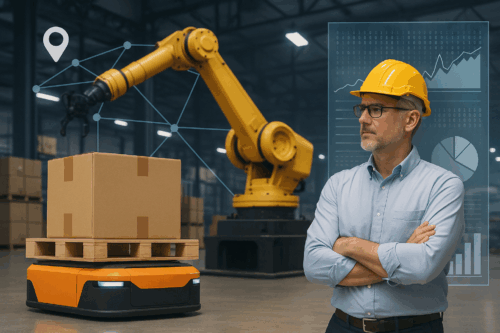
The Future of Manufacturing: Lessons from 2025 and the Road Ahead
If 2025 made one thing clear, it’s that the future of manufacturing isn’t just about cutting-edge innovation—it’s about being safer, smarter, and more connected. Over the past year, manufacturers navigated a rapidly changing landscape marked by labor shortages, supply chain volatility, and global uncertainty. In response, what were once considered long-term goals—like automation, system connectivity, and real-time data use—became critical components for day-to-day success.
As the industry evolved, manufacturers discovered the power of blending advanced technology with a people-first approach. This synergy is now shaping how we define efficiency, safety, and workforce strategy.
Here’s a breakdown of the most impactful trends from 2025—and how manufacturers can harness them to thrive in 2026 and beyond.
Automation That Supports People and Safety
Automation reached a new level of maturity in 2025, shifting from a “job replacement” narrative to a “workforce enabler” reality. Technologies such as Automated Guided Vehicles (AGVs), Autonomous Mobile Robots (AMRs), and Automated Storage and Retrieval Systems (AS/RS) played a major role in improving warehouse safety and efficiency.
By taking over repetitive or hazardous tasks, these systems helped reduce injuries and burnout, allowing employees to focus on more meaningful, skill-based work in safer environments. This kind of smart automation not only increased productivity but also contributed to stronger workforce retention.
Labor shortages remained a significant challenge throughout the year. The Bureau of Labor Statistics reported a manufacturing unemployment rate of 3.8% in August 2025—an 8.57% increase from the year prior. A Deloitte survey revealed that 65% of manufacturers ranked recruiting and retaining workers as their top concern. In response, many facilities embraced automation not just for output—but as a tool to attract and support their workforce.
Balancing Innovation with Human Oversight
While machines can handle much of the heavy lifting, human oversight remains irreplaceable. In 2025, manufacturers leaned into a model where human expertise and automated systems worked together to make better, faster decisions—especially in areas like quality control, safety, and troubleshooting.
Facilities that succeeded didn’t automate for automation’s sake. Instead, they strategically integrated technology while redefining employee roles to maximize the strengths of both. This approach fostered collaboration between people and machines, leading to more agile and resilient operations.
Driving Efficiency Through Interoperability
Geopolitical instability in 2025 introduced new disruptions across global supply chains and trade networks. As economic volatility grew, the need for scalable, adaptable systems became more urgent.
One standout solution? Interoperability.
Rather than relying on isolated systems, manufacturers began integrating robots, sensors, software, and even charging infrastructure into unified ecosystems. These connected environments enabled real-time communication between technologies—boosting transparency across the supply chain and increasing flexibility on the production floor.
This level of integration proved especially valuable for facilities operating under workforce constraints. Interoperable systems helped streamline cross-functional decision-making, reduce downtime, and enable a faster response to unforeseen challenges.
The Rise of Data-Driven Manufacturing
While data has always been a part of manufacturing, 2025 elevated it to a key competitive advantage. In an unpredictable economic climate, real-time analytics became essential for operational decision-making.
Manufacturers leveraged data for everything—from optimizing shift schedules and monitoring equipment health to tracking workflow efficiency and ensuring safety compliance. Predictive insights also empowered teams to move from reactive to proactive strategies, anticipating issues before they impacted performance.
As we move further into the digital age, data isn’t just a reporting tool—it’s a strategic asset that drives smarter planning, stronger safety, and better outcomes.
What 2025 Taught Us—and What’s Next
Ultimately, 2025 underscored that the most successful manufacturers are those who integrate innovation with intention. Safe, data-driven, and interoperable systems will define the next chapter of the industry—but only when paired with strong strategies and empowered people.
Going forward, manufacturers must view their facilities as unified ecosystems—where automation and human talent work hand in hand to drive long-term success. That mindset will be key not just for surviving—but thriving—in 2026 and beyond.